I feel like rubber bullets should be serialized, so you can know who fired it. It shouldn’t be too hard, they’re both extremely large and consumed in relatively small quantities.
Why in the world? You'll have no trouble finding videos of police blatantly misusing them in broad daylight. There are no consequences because... there are no consequences. Why would serializing rubber bullets help? Are we going to collect handfuls of them off the ground and then conjecture as to which officer fired which bullet?
They're not penetration rounds, so will likely ricochet off the individual. After which, they'll co-mingle with the rounds scattered around by all of the officers. Except in isolated cases that don't involve multiple officers, but then the serial number is a moot point.
So while a serial number can prove that a particular round came from a specific officer, proving a direct connection between any specific damage and a specific round would be an area of uncertainty and conjecture.
And even if you do keep track of an individual round, the above argument itself would allow for officers/lawyers to argue that case anyway, introducing enough reasonable doubt to weasel out of repercussions.
Why would it matter who fired it? Police are not holding police accountable for violent assaults.
Even if you were to ID the attacker, qualified immunity prevents you from suing them personally for violating your rights. You sue the police department, and then the taxpayer pays the settlement, and the cop suffers no negative consequences.
> A white Minneapolis police officer who knelt on George Floyd’s neck opened fire on two people during his 19-year career and had nearly 20 complaints and two letters of reprimand filed against him.
Yep they come in a handful of sizes. The more common size for these protests seem to be around 2 inches in diameter.
To put that in perspective, try to make the largest circle you can make with your index and thumb (think OK symbol shape). That's more or less the shape of these things and they are effectively a thin layer of rubber with a solid steel core. The inside of your finger circle is the steel and the thickness of your fingers is the rubber.
It does help, thanks, and it's also terrible, because it sounds like the police would think "oh it's fine, these things aren't lethal" and then shoot people willy-nilly with what are basically big steel cylinders.
Some are, usually they’re packed into 12ga shot shells, but those are limited in their velocity due to their tendency to penetrate rather than bounce off the victims. The bigger ones are able to strike further and harder with a reduced risk of penetration.
At the paintball size it’s now more common to see CS filled paintballs. Those don’t require a huge amount of kinetic energy to work, although exposure to CS gas has its own long term side effects.
Those paintballs are filled with oleoresin capsicum (OC) which is a far more persistent and "persuasive" substance. Getting hit with a CS paintball would be ineffectual due to the small amount and the fact that it wears off quickly.
What "long term side effects" does CS have? The US Army (at least) routinely puts all soldiers through a CS filled gas chamber as part of chemical warfare training and has done so for decades.
There are no longitudinal studies, because it is very difficult to find a sample of repeatedly tear-gassed subjects over relatively long timeframes. Hong Kong is a good example though, where estimates are that ~90% of the population have been exposed. In Hong Kong, long-term exposure has been connected with rashes, respiratory problems and chloracne.
I see from another reply from him that herewulf that you reply to has been repeatedly exposed to concentrates cs over multiple years.
eitland has been exposed to concentrated cs at least once, Anigbrowl multiple times including more than just once just this last week and it seems to be common in military training from what I read so I guess it is in fact well studied and reasonably harmless compared to many alternatives.
That said I agree with a number of people here that in most cases the best alternative might be to talk to people instead, and to not kill suspects in custody, obviously, and also to not handcuff and throw people on the ground when all that should be necessary was to ask simple questions.
That's extremely optimistic and I admire you for thinking of it.
Surely though simply requiring all police officers to have their cameras on 24/7, with instant firing for switching them off while on-duty, or taping them. I've seen both during the protests. When the cops killed the BBQ guy, it was like 50 officers on site. All had their cameras off.
I'd agree that traceable rubber bullets is for much further down the line. First you need prosecution of any officer shown using a gun at a person's head or upper-torso when they're not responding to a situation of immediate threat of loss of life. Seems the evidence should be there for that.
Swift prosecution, and where appropriate conviction, of police abuses would help to quell the current unrest IMO. Like on Reddit yesterday I saw video of an officer placing a stick in an already subdued persons hand, then beating them in the head and retrieving the stick ... is there any reason that person isn't already in jail? They should fast track prosecutions, have them in prison - of found guilty - by the end of the week.
Swift, open and impeccable justice is called for.
You can't entirely blame individual officers IMO, watching riot footage knee-on-neck is clearly a widely adopted technique, presumably it's taught. And putting someone in a riot with a weapon, we should expect aggressive actions, it's a natural human response that can't easily be trained out.
Mandatory gun cameras for riot police might be useful as this point though?
I don't think that would help as the bullets would eventually end up on the group with no accountability of who it hit or was aimed at.
I think it would be better to have a camera that takes a picture every-time a trigger is pulled. Then again nothing stops them from finding a way to disable it like the body cameras.
Unfortunately the mainstream has portrayed "antifa" as some kind of covert organization acting inappropriately. They fail to point out that antifa is literally short for anti-fascist. In other words, unless you're pro-fascism, you're anti-fascist by default. It's akin to calling yourself a liberal or conservative.
No. Antifa is more than just anti-fascist, and not everyone who is anti-fascist is Antifa. There are plenty of people who are not pro-fascist, but also are not pro-brawling-with-the-Proud-Boys-in-the-streets.
In fact, the Proud Boys could use the same logic. Are you ashamed of America's heritage? No? Then you're one of the Proud Boys. The logic in either case is completely false. In fact, this is one of the standard fallacies, but I can't remember the name of it.
This is not how it works. Antifa has a specific meaning. Similar to how having carbon in a product is not enough to say that it is organic. Or how just publishing your source code online is not enough to make your program open source.
I keep hearing this from the mainstream, while at the same time politicians keep going on TV saying things that aren't true, or are misleading. I think the politicians are using tactics from the "how to stop riots" playbook, but they don't work in a world where information flows freely. Probably the best example of this is how the authorities in Minnesota lied about 80% of protestors being from out of state, and when someone went through the arrest records they found this was entirely false, and that in fact the vast majority were from MN, and most were locals[0].
They've been trying to use this tactic elsewhere (I've been hearing it from de Blasio and Cuomo), but I don't think it'll work anymore. Politicians don't want to acknowledge that the riots are the result of angry citizens acting out in the only way they have the power to act, which is through disorderly conduct, because the system doesn't work for them.
As I write this, I can hear concussion grenades going off outside my window (I live in the middle of Manhattan) for the 5th or 6th night in a row. Every night I've watched thousands of unarmed peaceful protestors march by, demanding action. Meanwhile the NYPD is out in full military gear firing chemical weapons and rubber bullets indiscriminately at anyone who looks at them the wrong way.
I guess my point is that the disinformation is coming from the officials too, so everyone needs to look hard at real evidence before jumping to any conclusions. Please don't fall for the appeal to authority fallacy.
NYC resident saying police is letting people loot without firing tear gas/rubber bullets in SOHO. That the only way the police could have intervened to stop the riots/protests (a crowd of thousands) would have led to it being more violent.
I agree with a lot of what you said and think you did a good job saying it!
> Every night I've watched thousands of unarmed peaceful protestors march by, demanding action. Meanwhile the NYPD is out in full military gear firing chemical weapons and rubber bullets indiscriminately at anyone who looks at them the wrong way.
I was forwarded an interesting newsletter today from Mark Manson. He talks about holding contradictory ideas in our minds and how uncomfortable that can make us. How much easier is can be to fall back on confirmation bias and fallacies of composition/division.
It’s much easier to think of the protestors as all peaceful and the cops as indiscriminate thugs than to wrestle with the messy middle of some rioting looters causing mayhem and mostly peace loving officers trying to deescalate.
I recommend reading it and I found it thoughtful and basically apolitical until the left learning ending.
My take: I don't think the government understands how must distrust there is for public institutions. The fact that they keep going on these pressers and lying to the public, only to be discredited after the fact, shows how tone deaf and disconnected from reality the politicians are. What's even more bizarre is all the people who are cheering on the police brutality, and encouraging more violence against unarmed protestors.
There are systemic issues all throughout the government, and as long as cops keep killing people the riots will continue. Maybe they'll temporarily subside, but when the next killing happens it will flare right back up. Cops operate with impunity, and the politicians go on TV apologizing for them because they're afraid of the police too. Just look what happened to de Blasio's daughter, who was arrested by the NYPD under questionable circumstances.
It's crazy watching this all unfold, but if real change isn't implemented soon it will continue to foment. It doesn't help that along with racism, there's significantly economic inequality. Real unemployment is somewhere around 24%[0], food prices keep going up[1], and many still haven't been able to access unemployment benefits.
> What's even more bizarre is all the people who are cheering on the police brutality, and encouraging more violence against unarmed protestors.
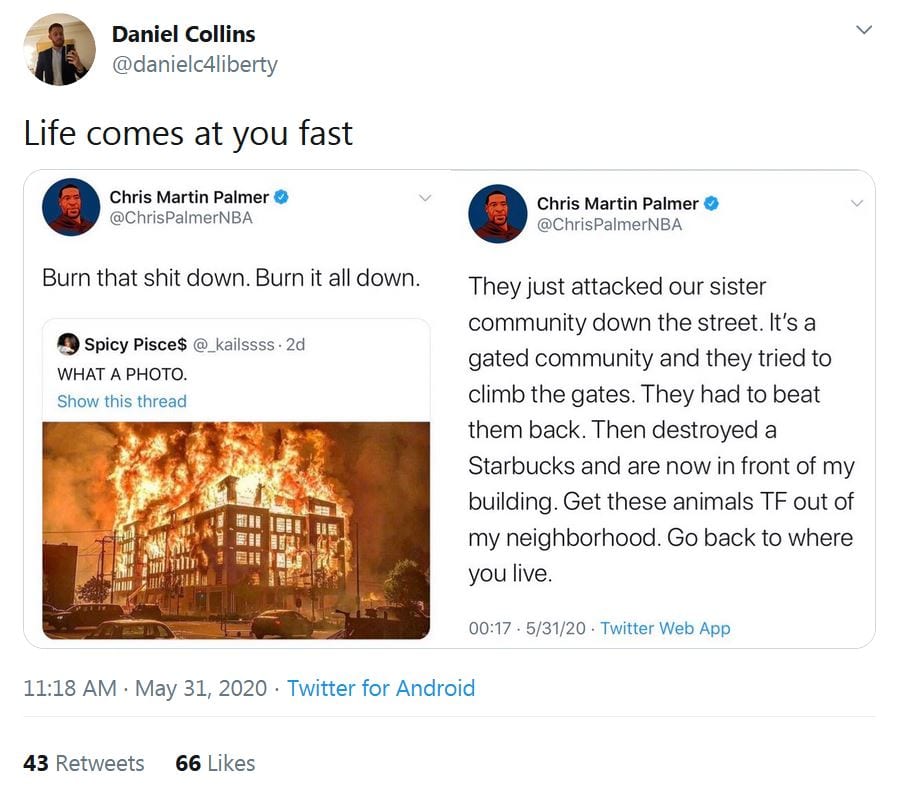
There’s lots of people cheering on the violence. The strangest are the white collar professionals, the celebrities, and the executives. I will say, in a few instances it felt good when these Twitter agitators got spooked as the violence they wished upon others neared their own gated neighborhoods (and I don’t say this lightly as my neighborhood is being terrorized right now).
Historically they used to do this for slaves where they would fight each other for entertainment of the elites or upper class people. It seems perfectly in align with that.
> But in a post subsequently removed from Twitter, the NYPD Sergeants Benevolent Association (SBA) accused de Blasio, 25, of “object throwing.”
> The account also posted de Blasio’s internal arrest file, which included her home address (Gracie Mansion, the mayor’s residence), ID number and other personal information.
The government isn't a single person or even consistent entity. Different people and groups are vying for control via control of the government. Some people distrusting the current government and others supporting it is pretty much what politicians want (it's also the natural result of politics).
I don't think this will change much when it comes to governing. Hopefully there will be change with how the police work in the US, but the political play is going to stay the same. Some people might just end up being switched out.
Just think of it this way: almost all of the rioting/protesting is happening in blue areas. They have a Democratic mayor, police chief, state representatives etc. The police are under the control of these local officials, not federal officials. At the same time, many of protestors are angry at Trump and other Republicans on a federal level. So who do they vote for to enact change? Voting for those same Democrats in local ejections keeps the status quo, but at the same time they don't like the opposition (Republicans). They can elect a different federal president, but that isn't going to change the police issue as long as the local status quo remains.
All in all, I would say that politically not much is going to change.
Technologies: I've used most of the trendy tools at some point, check my GitHub profile (below). I've started several companies (all of which were failures), and have also worked at several successful startups including Airbnb.
I've been turned down on several occasions for being "overqualified" or "too experienced". While I don't know the real reasons, I think in most cases there was a) the concern (from the employer) that I'd be too expensive and b) an unwillingness on my part to put up with BS (which is true).
I feel like it's a good time for a revival of BitTorrent. There was a lot of excitement for it back in the day, and while it still exists it's definitely waned in popularity.
Trying to do something like share a file with friends on the internet is still really hard to do. I know here are websites for this (like send.firefox.com) but it's still much harder than it should be.
I also worry that Big Tech is slowly trying to kill the URL (and the website in general). The move away from the web toward apps is bad for end users, but good for advertisers and companies trying to extract money from people.
I can't imagine a simpler way to share a file to friends/family vs Send. And I don't mean that facetiously I mean I literally cannot imagine. You open the site on whatever device you are on (no account needed), drag/select the file, and give the link to your friend/family. They don't need a special client or account either they just click the link on whatever device and the file shows up.
The only way to remove any of these steps in any sharing scheme is to preassociate a sharing group permanently which is inherently more complicated for all involved unless you're going for a "stream of shared files" result in which case BitTorrent isn't good either though.
As far as the implementation of the steps it couldn't be any more straightforward/smooth - simple design, not clogged with ads, good contrast, large letters, simple wording, easy to follow UI.
Resilio Sync (formerly BitTorrent Sync) uses a modified BitTorrent codebase to do much of what Firefox Send does, without user accounts or registration or even an email address. It would be nice to build this kind of functionality directly into and around BitTorrent proper. That being said, I use Resilio Sync as a free user on multiple platforms and like the product.
Presumably if you're speeding or driving while intoxicated, you're doing so intentionally. It's not as if someone is forcing you to drive too fast or too drunk. These things (especially speeding) dramatically increase the likelihood of being in a collision.
While I think that we should totally put the blame on drunk drivers, I would still make a distinction between negligence and intentionality.
Saying that drunk drivers intentionally kill people opens the door to saying that bad doctors kill people, bad medicine teachers kill people, people who vote for the wrong politicians kill people, politicians who enact bad laws kill people, etc.
At that point the discussion devolves into "your party kills people because your ideology is wrong", "no, yours is"
"Malfeasance" is the general term for doing something bad (usually professionally) for your own gain (or your own laziness), that can end up harming others, but where this is not the goal per se, just something that is an "acceptable loss" for your gain. An engineer who doesn't bother to verify the safety of a design before signing off on it, is committing malfeasance.
We distinguish this from "malice", which is when you do something with the direct intent to cause harm. An engineer who verifies that a design causes harm, and signs off on it because they want to cause harm, is being malicious.
Malfeasance is a crime, but it's one we actually can't catch very well, which is the reason we can't "do statistics" on it. Unlike with murder (where we almost always know that somebody caused someone's death, even if we don't know who; and therefore we can work out the statistics even without resolving the perpetrators); we have no idea (without thorough, expensive investigations that don't usually happen) how many of the e.g. buildings that fell over, fell over because of malfeasance, rather than because of a complex accident.
Your aim isn't to kill anybody. A careless maintenance worker in a factory also doesn't intent to kill someone when he intentionally skips a job. Or a shopkeeper when he sells cigarettes to a customer. You would end up including nearly all deaths as caused by humans if you go down that road. The bus driver who gave an overweight person a ride instead of making them walk.
Well, my point was that most automobile collisions aren't 'accidents' in the true sense of the word, and most automobile related injuries (and deaths) occur when someone does something negligent. The vast majority of collisions are caused by some combination of being distracted, intoxication, speeding, or just being reckless. Deaths (or serious injuries for that matter) rarely occur at low speeds, it's most often in situations that involve speeding.
There's a lot of data[0][1][2][3] to back up the correlation between speed and deaths, that's the whole focus of vision zero[4].
But how do you exclude all those other causes? We know that cigarettes kill people too so if you intentionally sell them to somebody, you're being reckless or negligent too. It's a continuum so where do you draw the line? At breaking the law? That's arbitrary and depends on the country.