It might have been, say, three years under construction, with a contract dispute interrupting construction for 2.8 of those years, the bridge sitting half-constructed and getting rain-weathered the entire time, and then just finally this month, construction resumed, was completed, and the bridge opened.
You know, like most Canadian buildings.
(Here in Vancouver, I see plenty of stick-built buildings left half-constructed due to developer or zoning problems, with their frames and plywood panelling just left exposed to the elements for months; and then construction resumes and the building has sheeting and cladding and insulation slapped on over just a few days. I've always wondered whether that traps in the moisture that's accumulated in the wood over the previous months, leading to those buildings having mould problems later on...)
Not sure where you got that idea from, but as a structural engineer in Vancouver I generally see the exact opposite. Once construction starts, it's an all out scramble to finish as quickly as possible.
Also, zoning problems occur at the building permit stage, which is well before construction starts.
I only know what I see walking around the neighbourhoods I frequent: buildings (usually single-family dwellings, but sometimes low-rises) that have sat half-completed, with no active construction, for months or even years.
I’ve always assumed it was a result of either the development company or their general contractor going out of business / running out of budget before completion; and that, when construction resumes, it’s because the site has been liquidated and sold at auction to a new developer.
Other times, buildings (usually commercial) are left 90% finished for years at a time—clad and insulated, but not wired or finished inside. I assume this these buildings are actually as finished as they’re going to get, and are for sale, waiting for an initial owner to decide how they want to finish them (instead of having to rip out and redo the previous interior and exterior), and they just aren’t being publically advertised. They still look kind of like blighted abandoned buildings, though, and kind of destroy the character of a neighbourhood in a similar way to the half-built homes.
You can both be right! Most buildings could be finished quickly, but at any given point time there will be more delayed buildings than ones being quickly constructed. This is for the same reason that most people who go to prison in the US do so for a sentence less than six months, and yet the prison population at any point is mostly people with > 10 year sentences.
If you want a "fun" story about an unfinished commercial building, just google "I-4 eyesore".
Down in Orlando (actually Altamonte, but if you're not from Central Fla, it's Orlando), there's a building a local mega-church has been "constructing" since 2001. They wanted to build it with no financing, and kept putting construction on hold every time they ran out of funds. Pretty sure at this point they've spent more in property taxes for a building they can't use than they would have spent in interest if they'd just financed it from the start, but, shrug.
It's a pretty ugly building design to begin with, too. All those mirrored windows are blinding when the sun hits them the right way.
That's one freaky building but organizers probably figured ...the Lord will provide which can be countered with Aesop's Hercules and the Wagoneer moral the gods help those who first provide the gods something to work with (ie labor and resources not just wishes). On observation, how lax have the lower-medium-income housing building codes become in the Orlando area? I live in a sprawling one-story house built like a concrete bunker in SW FL which survived the 140mph winds of hurricane Charlie and others (also helps it's 21 feet above sea level so somewhat immune to surges), with damage only to a pool cage. But in hurricane aftermaths you saw flimsy garden apartment frame-construction type structures demolished by broken trees and flying debris. Yet today you still see relatively dense pack housing being constructed the same way. Seems sad, knowing their inevitable fate.
They swear it will be finished this year, which they've said before, but there is actually construction currently ongoing at the site, which is a good sign, I suppose. I live north of Orlando, so I have to drive by it anytime I head that way.
As for building codes, I'm not sure. I just moved back down to central Fl after living in Gainesville the past 20 years. I do know that 30 years of living in Florida has taught me to never buy a mobile home. Hurricanes flatten those. I feel bad for the folks that don't have the ability to afford something more sturdy.
There's a lot of new construction in the next neighborhood over from mine (old golf course turned housing development), but I'm not sure if they're stick-frame houses or concrete. It's also an upscale development, not lower-middle-class.
Fair enough, single family homes are a different story because holding costs are so low, and the owner is usually financing the construction. Larger projects have significant construction mobilization (just the crane is costing hundreds of thousands) and the developer has already presold many or all of the units. I would estimate bankruptcy happens on less than 1% of our projects (we design about 30% of the residential towers you see being constructed in the lower mainland). That number probably shoots up for smaller projects.
Commercial units are left that way even for leasing, because the tenant will come and finish it to their specifications (once a tenant is found).
For these large projects, I've noticed something else that I've been curious about: condo projects that sit as empty lots with "coming soon" banners around them, for years at a time before they begin construction.
What's up with that? My first guess: by the time the developer gets zoning approval, the contractor they've retained has taken other work, and now they're waiting in line.
Yeah, a lot of the delay is coming from the rezoning and permitting process. There are crazy wait times for large projects because of the large queue of applications, understaffed planning departments, public consultations, and semi-extortionary negotiation over community amenity contributions (CACs). Often the trades aren't brought on board that early because the delay and uncertainty of whether the project will go forward. Once a permit is received, then it's usually full steam ahead and we are often asked to product tender and construction drawings in impossible timelines.
I remember seeing nearly finished building in Croatia, lacking only the exterior finish, but (apparently) with people living Inside. I first though it was a cost-cutting measure, saving on seemingly unecessary work, but I've also heard it was to avoid taxes on buildings.
When I first moved to Romania I saw the same and always wondered why. Now I built a small home and left it like this so I don't pay taxes (wanted to build, leave there a year of two and sell).
You also don't pay as much taxes when sold not finished.
Haiti had/has the same rule: property taxes only applied to finished structures, so many of the rural dwellings were left unfinished.
When my wife volunteered there right before the earthquake she said that many structures had exposed rebar sticking out of the concrete. She thinks that increases the fatalities significantly.
That was my exact memory of Croatia - I remember so many nearly finished buildings with "rebar" sticking out of the top of walls or unfinished exteriors - and they looked like they'd been that way for a while.
Personnaly I did not see that many of them and they were all inland, not on the coast, where the housing market might be different.
Also the remnants of the war had a much bigger impact on my memories of the country: we saw a few buildings still covered with bullet holes and areas cut off because of mines. That nearly two decades after the war such things were still visible was an interesting experience.
There's a building in development just down the road from me. It's been in a half finished state for almost two years. It spent the year before that as a hole in the ground. The lot next to it has finished one highrise and nearly completed another and a group of town houses in the same time period. The unfinished site also has a far smaller crew there regularly and will go weeks at a time with no activity.
I figure the other developers keep running out of money. To be fair, developers of the completed building, Leddingham-McAllister paid people to come from China to buy units. I spoke to a few of them one day when I seen them lined up down the road.
The company paid for their airfare and hotels so they could come purchase suites in their apartment complex. This was before construction actually started. I never seen any lineups of paid foreign buyers at the other one.
On another note, all the developments that have been completed in the almost ten years i've lived where I do, have remained at least half empty. Most of the suites have never had lights on orbeven curtains put up since they've been built. No ones ever lived in a good majority of the empty suites around me.
And at least one group of them are used for prostitution. I regularly see ads posted nearby offering girls $2000 a week and such to live and work in the buildings.
> The Saskatchewan Association of Rural Municipalities inspected the bridge earlier this year and told the RM that it would need to be replaced as it was rotting and dangerous.
> The municipality put out a tender and selected Can-Struct, who had been working on the project for the last four or five weeks.
They could very well end up with expanding plywood or osb syndrome, which makes the building much less structurally sound and might require expensive repairs down the line. Mould would be the least of your problems!
The two remaining road sections aren't level with each other. I'm not a bridge engineer, but it looks like the supporting columns on the near-side may have sunk and snapped the centre-span at that point, which then sheared-off at the other side due to lack to support.
If that photo is anything to go by it looks like the concrete beams forming the centre span were not supported by the horizontal I-beams, causing the span to fall into the river below. I'll have to assume the centre span originally did rest on those I-beams so it would seem that they have moved, either during construction or due to some external influence.
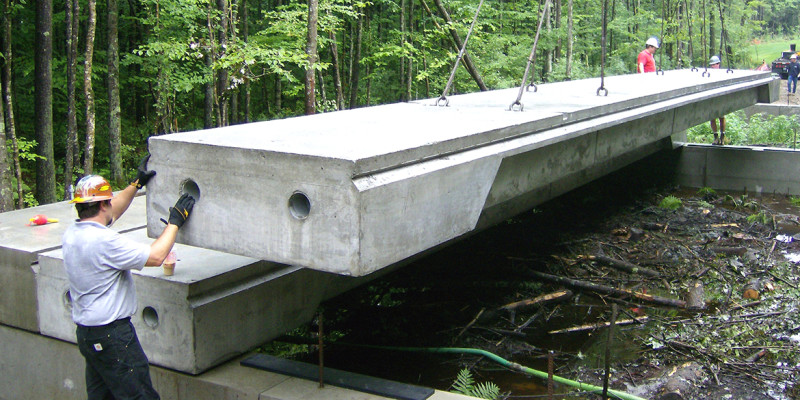
Look how cleanly the center span has split into six. It must have been made of six precast concrete beams [1] which would have been lifted into place by crane. You don't see any exposed rebar because the deck beams themselves haven't broken.
Shame they fell off when the blue metal pier sank.
It looks like the center span was not supported by the vertical bridge supports. It makes one wonder what the engineers were thinking - even the construction people should have questioned it.
On the far pier, the diagonal braces are a meter above the water, while on the near pier they're 20cm below the water.
My bet is when it was constructed the two piers were at the same height, and the center span was supported on both ends - then the near pier sank, allowing the center span to slip off.


https://s.aolcdn.com/hss/storage/midas/984273818587a1353cda1...
I'm not saying it's not new... but it doesn't _look_ new.