It would have been better for Turing if the government left him alone instead of chemically castrating him and driving him to suicide, then venerating him.
Ah cool, missed that completely. I thought this was the source that would be posted but of course the same story can be posted from different sources. (It was posted from this one as well, three times and none of those made it).
These announcements always make me ponder about the people we'll put on bank notes or erect statues in honour of in 50 years and are alive and persecuted today but not recognized by society.
Counter: obsolete things last longer than you think.
Riposte: obsolete things are not used by most people.
Counter-riposte: still used by many people.
Counter-counter-riposte: technically, many != most.
Somewhere, I think the original point was lost. This has been HN comment theater, the greatest arena of technical-yet-irrelevant correctness you can find.
It's all moot anyway. Banks don't issue £50 notes and nobody accepts them.
Which is really very weird because a fifty now is only worth what a twenty was when I started work. And back then twenties were commonplace and fifties weren't especially rare.
I suspect they only exist now to facilitate sketchy payments by HMG.
We bought an old FM radio - a beautiful NAD [0] from the 80s for $40, as it happens - because we like having music on in the background and the iPad/wireless combo just isn’t anywhere near as good as “the wireless”.
You know what the NAD has never done? Just stopped playing for no reason. Stopped playing because someone called. Stopped playing because a video played on a website. Stopped playing because the battery ran out. Stopped playing because my wifi did whatever. And so on, so forth.
> .. Stopped playing because my wifi did whatever. And so on, so forth.
> We listen to vinyl for the same reason.
Agree with your points entirely, except, you can't even get a whole album play through on vinyl without interaction.. modern information density is much improved.
HD vinyl [0] should be interesting, if just for that reason alone. Old tech, modern twist.
Turing was persecuted, but he was also instrumental to the Allies' victory in WWII. Without Bletchley Park and the massive advances in electromechanical computing that Turing helped to spearhead, the world would probably look very different today.
It seems more like an acknowledgement that his past persecution shouldn't have any bearing on our perception of his myriad accomplishments. FTA:
>Alan Turing provided the theoretical underpinnings for the modern computer. While best known for his work devising code-breaking machines during WWII, Turing played a pivotal role in the development of early computers first at the National Physical Laboratory and later at the University of Manchester. He set the foundations for work on artificial intelligence by considering the question of whether machines could think.
I mean, we sometimes call general-purpose computers "Turing Machines", and we use "Turing Tests" to determine if an AI can demonstrate enough intelligence to pass as human.
> Without Bletchley Park and the massive advances in electromechanical computing that Turing helped to spearhead, the world would probably look very different today.
That's an unnecessary exaggeration. ULTRA was incredibly helpful to the Allies, but there is little reason to believe that without it the world "would probably look very different today". In all likelihood the worst scenario is that the war would've ended a bit later, and with somewhat more favourable conditions for the USSR in terms of their positions in Europe.
If I recall, ULTRA played a non-trivial part in the Dunkirk landings by checking what the Nazis actually knew. Without that intelligence, it may not have succeeded and things could indeed look very different today.
Moving on from that, one of the people behind ULTRA went on to develop what we would recognise today as the cloud. In terms of cryptography, ULTRA was classified for decades after as the techniques developed were still in use.
Turing was accomplished enough that I think he deserves the recognition even had he not ended up unjustly persecuted for his sexual orientation.
I wish there was more focus in this discussion on Turing's incredible accomplishments and less on the lurid details surrounding his death. I'm fine with taking a stand to promote LGBTQ rights and left another comment here doing so, but I think it robs Turing of some of the respect he is due to frame the discussion here with an excess emphasis on his persecution.
I think the 2008 Recession will be just as memorable as the Vietnam War or the fall of the Soviet Union. It has amplified a lot of problems that we will probably still struggle with in the future.
Getting elected as the first black president in a country founded on the enslavement of black people is a pretty impressive accomplishment in and of itself.
"Founded on the enslavement of black people" is at best a misrepresentation of reality, and at worst a counterfactual statement. The bulk of the Northern states abolished slavery by 1810. The founding principles were at odds with slavery, to the point that many southerners objected to the Declaration of Independence's claim that all men are created equal. Some parts of the US did tolerate the contradiction between its founding principles and slavery for close to a century, and this contradiction between slavery and America's founding principles culminated in a Civil War. There is little merit to the claim that the US was "founded on the enslavement of black people."
Several US states were the first governments to abolish slavery in the entire New World. Even if we're explicitly talking about national level abolitionism, the United States was average in terms of the time it took to abolish slavery in the Americas. Slavery continued until 1873, 1886, and 1888 in Puerto Rico, Cuba, and Brazil respectively. Chile, Argentina, Colombia, and Venezuela abolished slavery in the 1810s and 1820s but only prohibited the enslavement of newly born children while allowing the continued enslavement of existing slaves.
Hyperbole about slavery in America's founding aside, being the first President of direct African heritage is an achievement that would be worthy of being put on a banknote.
Reading "all men are created equal" like that is ahistorical. The Declaration of Independence asserted that at the same time as those northern states kept slaves (and would for decades to come), and natives being driven from their lands like cattle. Clearly "all men" was less inclusive than it's thought of today.
And just how long does it take to found a country? In 1789 there were around 4 million people in the US, and slavery was legal in most of the country whether measured by area, economic output or population.
Even if you take 1810 as the cutoff that's 34 years after independence. Would you say 34 years after the founding of some 20th century nation states (some of which collapsed a lot sooner than that) that it was too early to tell what principles they were founded on?
It's also a very narrow view to say that a southern state producing cotton where slavery was legal, and a northern state where slavery wasn't legal but where cotton production with southern material contributed significantly to the economy weren't both involved in slavery.
The principles of universal equality expressed in the Declaration of Independence were indeed interpreted by many as delegitimizing slavery. For example, the Massachusetts constitution included similar language, and this was subsequently used to ban slavery.
34 years is a heartbeat in the overall span of history. Furthermore some states, including some of the most populous ones like Massachusetts abolished slavery less than 5 years after the founding of the United States, and many did so before 1800. Many of the authors of the Declaration of Independence intended slavery to be phased out, and Jefferson banned the importation of slaves during his presidency. It's difficult to claim that the US was founded on slavery when states started to ban slavery almost immediately after its founding and key founding figures took steps to curb slavery.
To say that slavery was a "founding principle" of the United States does not have much justification beyond the fact that slavery existed at the time of the United States' founding. By that metric, effectively all countries founded during the New World revolutions of the late 18th and early 19th century were founded on slavery.
You're the only one bringing up a "founding principle", which shifts the discussion from reality on the ground towards legislative philosophy.
Everything you've said here and in the sibling comment makes the case for the irrelevance of those declared policies. If they were important you'd expect the US to have abolished slavery relatively early, or for it not to have been such an important issue as to have precipitated a civil war within its borders.
To say that a country is "founded on" something speaks to its early development. For instance the modern Icelandic state is arguably founded on its fisheries, and the US can be said to have been founded on sustenance agriculture, the economic surplus of slavery etc.
> You're the only one bringing up a "founding principle", which shifts the discussion from reality on the ground towards legislative philosophy.
The reality on the ground is that most of the US was the first country in the Americas to take steps towards abolition, most of the country by population had banned slavery within a few decades, and it was banned nation wide within a century. I had assumed people were talking about "founded" in terms of founding principles, because trying to justify the claim that the US was founded on slavery based on "reality on the ground" is even harder to defend.
> If they were important you'd expect the US to have abolished slavery relatively early, or for it not to have been such an important issue as to have precipitated a civil war within its borders.
It was. The first state to ban slavery was Vermont in 1777 literally one year after the country's founding. Massachusetts, then one of the most populous colonies (I think 2nd or 3rd highest population) banned in in 1780. The majority of the country by population had banned slavery well within one lifetime after it's founding.
The fact that the country was willing to go to wage a Civil War to bring about the end of slavery is testament to the fact that that the country was not founded on slavery, I cannot fathom how one can convince oneself that this indicates the opposite.
> To say that a country is "founded on" something speaks to its early development. For instance the modern Icelandic state is arguably founded on its fisheries, and the US can be said to have been founded on sustenance agriculture, the economic surplus of slavery etc.
By this logic, the US was founded on subsistence farming, logging, fur trapping, manufacturing, shipbuilding, whaling, and countless other industries. Furthermore, using this logic one can claim that the entirety of the Americas, Africa, much if not all of the Middle East, and many European countries are "founded on slavery". The fact that the only way to defend the claim that the US was founded on slavery is take such an expansive view of what it means to be "founded on slavery" that it becomes almost universal demonstrates that there isn't much justification for this claim.
> I cannot fathom how one can convince oneself that this indicates the opposite.
Honestly I can't fathom how saying the US was founded on slavery is a controversial point.
The context of this thread is a discussion of the design of the British pound, and whether Obama being on the dollar would be seen as being notable by future generations because he's black given the deep history of slavery in the US.
I think you're trying to defend a strawman when purely discussing the US's slavery practice in the context of the Americas. If we're only doing that we'd focus on countries like Haiti and Brazil instead, but we're not. Furthermore it's a given that it's not notable that a black person's on Haiti's money given their demographics.
To say that a country is founded on something is to describe its overall character at the time. Almost a 100 years after the country's founding almost 1/5th of the population was enslaved[1]. More than half of the US's export earnings were from the products of slavery, dwarfing any other sector.
Comparing this to whaling would be comical if the subject matter wasn't so sad, and so is cherry-picking the early abolishment of slavery in a few northern states who didn't have a notable population of slaves to begin with. It would be like Nebraska having outlawed whaling while most of the US's population & economic output was supported by whaling.
> Honestly I can't fathom how saying the US was founded on slavery is a controversial point.
Because it is incorrect. Slavery ran contrary to what the US was founded on, which is why those states that persisted in practicing slavery ultimately could not co-exist with the rest of the US.
> The context of this thread is a discussion of the design of the British pound, and whether Obama being on the dollar would be seen as being notable by future generations because he's black given the deep history of slavery in the US.
Yes, and in doing so the above commenter wrote that the US was "founded on the enslavement of black people". This is incorrect.
> I think you're trying to defend a strawman when purely discussing the US's slavery practice in the context of the Americas. If we're only doing that we'd focus on countries like Haiti and Brazil instead, but we're not. Furthermore it's a given that it's not notable that a black person's on Haiti's money given their demographics.
Some attempt to portray the US as uniquely persistent in its practice of slavery, and I pointed out that this is incorrect.
> To say that a country is founded on something is to describe its overall character at the time.
The US was overwhelmingly Christian at the time of its founding, and continued to be so for well over a century. The US was not at all founded on Christianity, it is an explicitly secular state (superficial things like the pledge of allegiance notwithstanding). This line of reasoning does not hold up to scrutiny.
Most people would say that a country is founded on something if that something is foundational to the country. Sparta was founded on slavery, for example. Slavery was foundational to Spartan society - a Sparta without slavery was an impossibility. One of the reforms of Lycurcus (arguably Sparta's most important founding figure) was to make the people Sparta conquered slaves owned by the Spartan state. That is an example of a country founded on slavery.
> Almost a 100 years after the country's founding almost 1/5th of the population was enslaved[1]. More than half of the US's export earnings were from the products of slavery, dwarfing any other sector.
It is intellectually dishonest to cherry-pick exports as though it is indicative of all economic output, as you do below. Slavery did not comprise the majority of the US GNP. Even if the analysis is exclusively limited to the South, slavery only compromised just over a quarter of economic output [1]. The industrialized North had an outsized share of GNP as compared to the south - estimates I find put the north at 3/4 to 4/5th of the US's total GNP in 1860.
> Comparing this to whaling would be comical if the subject matter wasn't so sad, and so is cherry-picking the early abolishment of slavery in a few northern states who didn't have a notable population of slaves to begin with. It would be like Nebraska having outlawed whaling while most of the US's population & economic output was supported by whaling.
The majority of the US economic output was not supported by slavery. Slavery contributed about 25% of the South's economy, which in turn contributed 20-25% of the total US GNP, so the share of GNP produced by slavery was ~6%. Most of the output of slave labor was exported, so even if you want to expand the scope of what was "supported by slavery" to include manufactured goods produced from cotton picked by slaves it is still a slim share of the overall economy. The notion that "most of the US's population and economic output was supported by [slavery]" is not even remotely true.
> Slavery ran contrary to what the US was founded on[...]
My understanding of your argument is that because certain nice and lofty things were said in certain founding documents we should look at it as a matter of historical inevitability that practices like slavery and racial discrimination were ultimately abolished.
I just don't buy that, and I think if you try to make this argument for any other country you'll see how silly it is.
I could similarly argue that say the oppression of the Soviet Union of its own citizens didn't have anything to do with its nature or foundational structure, it was just some temporary mistake. If you read the Soviet constitution it's even more unequivocal about condemning that sort of thing than the equivalent American documents.
For something like 1/3 of the history of the country millions lived out their lives as slaves, if we're being conservative for 2/3rds structural racial inequality was the law of the land.
If you'd have talked to supreme court justices, and some of the authors of those founding documents (many of whom had slaves) they'd have been appalled by this modern reading of the text. "All men" is much closer to the contemporary reading of "all [male] citizens [who hold property/are head of households]".
> The majority of the US economic output was not supported by slavery.
The page you're linking to makes the opposite case if you take it as a whole instead of selectively quoting from it. It argues that a buyout of the slaves would have been impossible due to the high price. Furthermore it's talking about numbers at the time of the civil war, almost 100 years after the period we're discussing, at that time the country had a more diversified economy.
If a sector of your economy is so integral to it that the government wants to get rid of it but can't see itself abolishing it without a war with itself it's pretty foundational to the economy.
> The notion that "most of the US's population and economic output was supported by [slavery]" is not even remotely true.[...]
Based on your reductive analysis of GNP by sector, but that's not how economies works. Low prices in one sector (e.g. due to slave labor) cascade to other sectors. The page you linked to explains this, it's like oil prices today. The benefit to the economy from reduced oil prices is higher than just the dollar value paid for the oil, it makes everything else cheaper.
But really. I don't see how we're going to get anywhere here (although I'd love to continue the discussion in this increasingly stale thread). How much slavery contributed to the economy is a supporting fact, but it's clearly not the main point. Although I'd be curious at what percentage of GNP you'd concede it. 25%? 50%?
The point is that a phrase like "built on slavery" accurately characterizes the country at the time both economically and socially as compared to other notable countries.
> My understanding of your argument is that because certain nice and lofty things were said in certain founding documents we should look at it as a matter of historical inevitability that practices like slavery and racial discrimination were ultimately abolished.
> I just don't buy that, and I think if you try to make this argument for any other country you'll see how silly it is.
Pointing to founding principles is but one of a variety of items I've been using to demonstrate the falsehood of trying to asset that slavery was foundational to the United States (early abolition movements, the fact that slavery comprised ~6% of GNP, that founding figures expressed desire to end slavery, and more). If genuinely believe, "that because certain nice and lofty things were said in certain founding documents we should look at it as a matter of historical inevitability that practices like slavery and racial discrimination were ultimately abolished" describes the points I've been making then I doubt you've been reading my comments in any detail. Did you just forget all the other points I've been making?
> I could similarly argue that say the oppression of the Soviet Union of its own citizens didn't have anything to do with its nature or foundational structure, it was just some temporary mistake. If you read the Soviet constitution it's even more unequivocal about condemning that sort of thing than the equivalent American documents.
One could make a decent argument that the worst aspect of Soviet oppression was a temporary mistake. The worst of Soviet oppression took place during Stalin's purges, and the Soviet government essentially disowned him after his death. Which was more oppressive, the Soviet Union outside of Stalin's reign, or the Tsarist regime that the Soviet Union replaced? Remember under Tsarist Russia a huge portion of the population lived as serfs, which were human property (serfs could be purchased and sold, perhaps not quite identical to slavery but at least in a similar stroke). Both were very bad, and I would be appalled if I had to live under either, but many see the Soviet Union as an overall positive delta.
> For something like 1/3 of the history of the country millions lived out their lives as slaves, if we're being conservative for 2/3rds structural racial inequality was the law of the land.
To be more specific, for 1/3rd of the history of the country, millions lived out their lives as slaves in ~40% of the county in which slavery was legal. Re-framing this to "structural racial inequality" is diverging very far from the claim that the united states was "founded on the enslavement of black people", which is the claim that I am disproving.
> If you'd have talked to supreme court justices, and some of the authors of those founding documents (many of whom had slaves) they'd have been appalled by this modern reading of the text. "All men" is much closer to the contemporary reading of "all [male] citizens [who hold property/are head of households]".
So now we're talking about the lack of female suffrage? This is diverging even further from the claim that slavery was foundational to the United States.
> The page you're linking to makes the opposite case if you take it as a whole instead of selectively quoting from it. It argues that a buyout of the slaves would have been impossible due to the high price.
Sure. That doesn't change the fact that slavery comprised 6% of GNP. But because the South only had 20-25% of the country's GNP, this represented 20-25% of the South's economy. It's not surprising that they would choose to fight. But that does not change the fact that slavery did comprise 6% of GNP - very far from the 25-50% you speculate below.
> Furthermore it's talking about numbers at the time of the civil war, almost 100 years after the period we're discussing, at that time the country had a more diversified economy.
Quite the opposite. Slavery during the time of the United States' founding was much less economically productive than it was during the antebellum period. Cotton, slavery's primary product, was not profitable until the cotton gin was invented which boosted cotton production by a factor of 25-50. Tobacco plantations were more popular than cotton before the invention of the cotton gin. Some scholars even speculate that slavery would have petered out without conflict were it not for the cotton gin. If you want to measure the economic output of slavery at the time of the US founding, it's drastically less as compared to 1860.
> If a sector of your economy is so integral to it that the government wants to get rid of it but can't see itself abolishing it without a war with itself it's pretty foundational to the economy.
Slavery became foundational to the Southern economy, but this was a development that occurred after America's founding. As as explained above, slavery was not economically very productive at the time of the United States' founding. "King Cotton" didn't come about until the invention of the cotton gin and westward expansion.
> Based on your reductive analysis of GNP by sector, but that's not how economies works. Low prices in one sector (e.g. due to slave labor) cascade to other sectors. The page you linked to explains this, it's like oil prices today. The benefit to the economy from reduced oil prices is higher than just the dollar value paid for the oil, it makes everything else cheaper.
> (and later) Although I'd be curious at what percentage of GNP you'd concede it. 25%? 50%?
Slave labor produced cotton, most of which was exported. While some of this did get sold internally to the North, the article I linked writes, "The first half of the nineteenth century witnessed an enormous increase in the production of short-staple cotton in the South, and most of that cotton was exported to Great Britain and Europe." The article does mention that "all regions benefited from the South’s concentration on cotton production" such as the north selling manufactured goods to the South. But it does not claim that this was anywhere near the majority. Again, the entire Southern economy comprised 20-25% of the country's GDP, and slavery accounted for 25% of that figure (5-6% in total). While the indirect contribution you refer to existed, it was not remotely close to the majority. Attempting to quantify this is difficult, because defining what kind of economic activity counts as being supported by slavery is ambiguous, but not scholar would put this figure near the 25 or 50% you speculate.
> But really. I don't see how we're going to get anywhere here (although I'd love to continue the discussion in this increasingly stale thread). How much slavery contributed to the economy is a supporting fact, but it's clearly not the main point.
Then what is the main point? So far we have established that:
* Slavery was not one of the principles the US was founded on.
* Abolition movements started effectively immediately after the US's founding, and the majority of the country was slave-free within half a century.
* Slavery, and economic activity related to slavery, did not comprise even remotely close to the majority of economic activity in the US.
* Most of the country's founders expected slavery to be abolished, including some that owned slaves themselves (e.g. Jefferson)
The only potential justification you have presented that slavery was foundational to the US is the fact that slavery existed at the time of the US's founding - that is insufficient to claim that this was foundational to the US, especially in contrast to the points I listed above.
> The point is that a phrase like "built on slavery" accurately characterizes the country at the time both economically and socially as compared to other notable countries.
No, it does not. America at it's founding at best tolerated slavery, and within a matter of decades society did not tolerate slavery. Economically, it comprised a relatively small portion of the economy. The comparison to other countries is even more egregious, and speaks to a profound ignorance of the role of slavery in other countries [2].
^ This is actually a very good visualization top to show just how much larger slavery was in 1860 as compared to 1790. In the latter slavery was pretty much exclusive to a couple narrow stretches of land on the coasts of Virginia and Georgia. Also note the difference in the legend between slave and free people.
* The principles expressed in founding documents contradict slavery.
* Some States banned slavery less than a decade after the country's founding, and within forty years the majority of the country by population had banned slavery.
* The contradiction between the founding principles and slavery ultimately led to a Civil War where the former emerged victorious.
* The United States' did not take an abnormal amount of time to ban slavery at a national level. And in fact, some States in the US were the first governments to ban slavery in the entire New World.
I'm pretty much at a loss as to how someone can come away with this comment thinking that nothing in my comment is refuting the claim that the US was founded on slavery.
Bitcoin has mainly thus far mostly allowed for some geeks to get rich and some criminals to move around money. It's actual impact on society is best described as it wasted a bunch of electricity.
Maybe, but crypto currency in some form could see widespread use at some point. Perhaps it won't be Bitcoin, but the underlying technology. Turing's machines weren't directly used, but the principles he came up with impact us today.
The enigma machines were typewriter like devices of nazi manufacture designed to allow users to type clear text and produce cypher text that could be typed into devices that shared a secret to produce the original clear text.
Alan Turing is known for
- Being a primary figure in the effort to break the enigma machine code so that messages could be decoded without stealing the secret keys used. This was tactically valuable.
- Creating one of 2 mathematically equivalent logical models of computation eventually shown to be equivalent.
He is thus of pivotal importance in the development of modern computers, the defeat of the nazis, and codebreaking.
If you haven't heard of any of this it behooves you to read up a bit.
> - Being a primary figure in the effort to break the enigma machine code so that messages could be decoded without stealing the secret keys used. This was tactically valuable.
That is obviously what I'm referring to, what are you on about? It would behoove you to refrain from needlessly condescending replies.
The post that I responded to said "Turing's machines," I assume this didn't mean "Turing machines" because that's an abstract concept so what would it even mean for it to be "used directly?"
All I meant to say is that machines designed/built by Turing were in fact very, very useful in their time. I was too lazy about it though and should have looked up the name in the beginning.
Its impact on global warming includes not only the carbon footprint of all the electricity it wastes, but also all the hot air and fermenting bullshit generated by people yapping and shilling about it.
What about pragmatic discussions in domains where clear data isn't accessible?
Deriving high probability conclusions from high probability premises?
>A greater number of people took psychedelics because they're more accessible due to anonymous, location independent markets
Likelihood of this not being true approaches zero IMO.
> Psychedelics change people's lives meaningfully
Sufficient research exists to back this up. Michael Pollan's book cites many.
> the kind of people who buy drugs on the internet are the kind that are demographically likely to experience positive life changes from psychedelics.
You may want to note: most would agree by volume, those buying psychs online are also distribute them with their social sphere. The dark net facilitates local area networks of psych access. There's no a 1st order relationship here.
If any legitimate currency were ever transitioned to a cryptocurrency backing, this would be an obvious choice. If not, it wouldn't. Although not knowing who is Satoshi Nakamoto makes it very hard to put his face on a banknote.
I don't think either of those deserve to be mentioned in the same way as Alan Turing, and no amount of time passing will change that. Note that Alan Turing was persecuted for what he was, not for what he did. I also don't think there will be an ACM award named for either.
What a crap comment, I can see why you chose to use a throwaway account. That's about the same as saying that a law against breathing would make all of us illegals because it is something that we did, rather than that breathing is a direct result of being alive as a mammal. Sex is a natural thing. If you outlaw sex then you are by definition creating criminals, and you might as well name it for what it is: a law against certain groups of people. The act itself is merely the stick used to hit them with in a legal way.
Hot take from a person too scared to comment from their their main internet handle.
People who so badly want to strike a win for their values over human empathy, equality, and compassion have to steer common sense arguments into the arena of pedantic details. They have so routinely gotten their butt kicked in the arenas of empathy, equality, and compassion so often they’re ashamed to say what they feel out loud, even with a made up internet handle.
They should embrace the shame, it might be the only thing left that tethers them to humanity.
> They have so routinely gotten their butt kicked in the arenas of empathy, equality, and compassion
Ah, gloating about "kicking butt", truly the pinnacle of empathy and compassion.
Look, I agree with you, but there's no reason to descend to this guy's level. As old Fred once put it:
> He who fights with monsters should look to it that he himself does not become a monster. And if you gaze long into an abyss, the abyss also gazes into you.
Yes dude, I feel you. “Butt kicked” = getting definitely out debated = society recognizing those ideals of hate are not valuable; however you want to phrase it.
Sometimes you don’t feed the trolls. Sometimes I read a thing on the internet that is so absurdly hateful and spiteful that nobody responds to and I worry “who out there is reading this, and might be on the fence about some human values. If they don’t see anybody responding to it at all, will they think it’s an acceptable view point?”
I’m not gonna save the world, but occasionally I can offer rebuttal to cultural biases.
The law against homosexual sex does nothing to increase the welfare of their fellow man and prevents individuals from finding fulfilling love. It was an evil law and people should be proud for defying it not ashamed because their love was stronger than your hate.
“If you want to build a ship, don't drum up the men and women to gather wood, divide the work, and give orders. Instead, teach them to yearn for the vast and endless sea.”
That’s poetic, but oddly terrible advice as we can actually build ships.
Longer lifespans is already a goal, but aging is unlikely to be “solved” in in the next 100 or even 1,000 years. People took much longer than that to figure out how to fly and we have been trying to solve aging for as long if not longer.
Consider buildings age as do diamonds. To fix aging we need to get bodies to do things like regrow teeth and replace the circulatory system. Growing extra lungs to replace lungs being filled with junk etc etc. When we start syncing redundant brains, that’s when we can start ending aging.
And at that point (and I'm venturing into philosophy here so sorry about that) am I still me?
If my brain has been downloaded (for lack of a better word) into another, am I living on in that other body or does someone else have my memories?
I've often wondered this about Star Trek-style teleportation. Are those red-shirts really moving instantly from one place to the other or are they being incinerated on a coloured circle and cloned somewhere else?
are you the same "you" that you were last night before you went to sleep? for all practical purposes, yes; if a perfect clone woke up in your bed this morning, it would make no difference to the rest of the world, and your clone would still have all the same problems and goals.
but the best evidence you have that you are the same entity as yesterday's "you" is that you remember some events from the day. the teleportation paradox is no harder to resolve.
And I'm really creeped out right now. I was about to type this example too and then didn't at the last.
As a side note - My mind tends to race at night. Life has me so busy during the day that when I'm trying to sleep is the only time I get to do much thinking. Thing is, because I'm already tired I never remember much of it the next morning other than "I had a really good think about something last night". Given that I'll not remember, and no-one else will have known, it does seem philosophically compatible and biologically possible that the current me is in effect "dying" every night to make way for a "rebooted" version tomorrow. This is not inconsistent with what we know sleep to be.
The only difference is that there's still only one me.
With the transporter analogy, though, the physical matter is reconstructed at the other side from different matter, which means its a copy. The film "The Prestige" covers this difference brilliantly if you've ever seen it.
Finally, if this comment makes no sense, it's because I'm in bed and my mind is racing.
All attempts to cure aging have been magic/religion-based until very recently. Also it's not like we "learned to fly" as if cavemen could have done it had they only known the right wing shape and arm technique. It was only possible because of an accumulation of industrial and scientific knowledge.
Significant life extension will likely be built off the same accumulation of knowledge, not some rainforest frog extract the ancients could have refined. The only way I can imagine we don't have this in 1000 years is if someone's nuke finger gets twitchy.
Want to accelerate research? Make "The Fable of the Dragon-Tyrant" required reading/watching for all schoolchildren: https://youtu.be/cZYNADOHhVY (That this might be controversial is itself interesting.)
Yet, for the first person to ride a hot air balloon took ~2000 years in 1783. Some of this came down to advances in material science, but far less than you might think.
What will happen is that you will have a bunch of very rich centenarians who will own just about everything simply for having a couple of decades head start on the newcomers. The same thing is already happening today. Unless you want to cap wealth and property this is not going to end well.
It's already at the point today where real estate and other relatively scarce resources are much more available to and owned by the wealthy who then use this to extract rent from the younger generations. Give those people another 80 years or so to do play the game and we will all end up in hock to them. You'll be born in debt to someone who was born a century or more before you.
If we're imagining a world with immortality why not imagine one with space colonies, or some other form of growth? The new people could get the new stuff, same as it's been since the end of feudalism.
Living forever seems inevitable to have unintended consequences, so it's hard to say whether it'd be a good thing or not. They could end up seeing it as a mistake.
Birth rate has fallen off a cliff. Nothing wrong with less people having kids also living longer if we can drive down our per capita environmental impact. Consider the value lost to humanity each time someone with decades of knowledge, wisdom, and experience passes.
Offer me immortality and I shall go explore the stars.
> if we can drive down our per capita environmental impact.
Oh is that all?
Like my Gammy said, “If ifs and buts were candy and nuts, we’d all have a merry Christmas.” And if you gave my Gammy immortality, she would’ve just smoked more cigs and played more nickel slots.
It's the year 2400 and recent developments in technology mean that a person (let's say John) can choose to live for 500 years, in favour of a chain of offspring.
John makes this choice.
John's father Harry would have made that choice had the technology been available, and would have enjoyed a longer life in favour of fathering John.
The only reason John exists is because the technology was not available to Harry - so what right did John have to exist that his unrealized offspring would not also have? (Given that their reasons for existing/not-existing are the same).
This is a remarkable chain of bad logic. We start with a real Harry a real person with real rights at point A and then proceed to discuss 2 different hypothetical points B and C where Harry did or didn't have a kid.
To discuss Johns hypothetical rights when he came into existence at point B makes sense. At point C he never did so its meaningless to discuss his rights. At A its possible to discuss B in context of B but impossible to be indebted NOW to entities in contexts in which they don't exist.
The breakdown is where we reason from B to A and assign every hypothetical being that could have possibly arisen the privileges of an actual existing person in A. B's possibilities are only reasonable in context of B.
To imagine otherwise we are stuck with accepting the murder of a googol potential slightly different children that could have resulted rather than the relatively few we had. Only slightly less absurd we could be morally obliged to have as many children as possible even if the result is that they are on net less successful and more miserable to avoid the greater loss of existence.
Reason it out yourself and consider the plethora of absurdities.
I have done. I could give several more reasons than you've listed above to support your own argument.
That's not the point, though.
John's kids are hypothetical.
But so is John.
As is Harry.
As is a 500 year old Aubrey de Grey.
Rights are what people decide they and others should or shouldn't be entitled to based on a consensus of what most of us consider to be, you know, morally right.
If there was consensus on the rights of people yet to live (who may or may not ultimately be born) there wouldn't be differing views on pro-life/pro-choice - and the terms would likely not exist.
To come back to the crux of your argument, though - I don't believe our John is any more responsible for a single potential offspring that doesn't come to pass than a father is for every sperm that doesn't fertilize an egg. That would be, as you've said, absurd.
My point was that suspending the natural cycle of life in a way that prevents pro-creation is, in my view, morally wrong. Something I imagine we disagree on.
It's good that Turing gets put on a banknote - and about time.
However, the concept art in that article is really ugly. I'm not that familiar with British banknotes - are they usually that messy looking? Every piece of text is in a different font, and it seems pretty vulgar to have a quote on the note at all. There's even drop shadows! It honestly looks like something I'd put together in Corel Draw in the mid-2000s.
I just got back from a trip to the States and I have to say that US money is very boring by comparison to UK money. How on earth do blind/old people deal with the fact that all denominations are practically the same size, design, colour etc?
I recently moved to the US and I hate its coins. To the point that I consider all of them unusable. When I get home, I leave all the coins that I received as change on a plate by the door, hoping someday I will bring all of them at once somewhere to change for bills (I believe there are machines that do this).
My complaints:
i) They do not have numbers on them!! You have to read words to know the value
ii) To make point i) worse, they have nicknames printed on some of the coins!! They do not write "ten cents", it is "one dime". They do not write "twenty-five cents", they write "quarter dollar" (even the unit here changes)
iii) To make points i) and ii) worse, there is no default place where the value is written. $0.01 is a horizontal banner. $0.10 and $0.25 are round-based by the edge of the coin. $0.05 is round-based, but not by the edge of the coin, just slightly above another text that is by the edge.
iv) The coins do not obey a coherent progression of value and size. From smallest to largest the coins are: $0.10 < $0.01 < $0.05 < $0.25
v) The colors are all the same, except for the $0.01 coin.
So when you have a bunch of coins, you have to properly spread them in your hand to be able to compare their sizes (which is hard when the items are circles), account that there is no size-value correlation, and if you do not remember by size; you have to read a tiny sentence, lost in the middle of several other sentences, with no typographic differentiation of where they are.
> ii) To make point i) worse, they have nicknames printed on some of the coins!! They do not write "ten cents", it is "one dime". They do not write "twenty-five cents", they write "quarter dollar" (even the unit here changes)
Those aren't nicknames. They are the official names of the coins as laid down in the Coinage Act of 1792 (though "dime" was originally spelled "disme") and its successors.
The vast majority of Americans have never read a coin to determine its value. They are all easily distinguishable by size and touch and your average American could identify them 100% of the time while blindfolded.
Unfortunately the paper money isn’t similarly touch-friendly.
The quickest way to recognize US coins is to recognize which of our four greatest presidents[1] is displayed on the coin: George Washington on the quarter (25 cents), Franklin Delano Roosevelt on the dime (10 cents), Thomas Jefferson on the nickel (5 cents), and Abraham Lincoln on the penny (1 cent). The only recent significant change to the front design is that Jefferson is looking at you on the newer nickels, rather than to the side as he did previously.
This is a completely arbitrary system, but American schoolchildren learn it very early on and memorize it, and it remains valid for the entire rest of their lives.
[1] You may recall that the faces of our four greatest presidents are also engraved on Mount Rushmore, except instead of Franklin Delano Roosevelt, Theodore Roosevelt is on the mountain. This is because Mount Rushmore was carved during the administration of FDR, and he had not yet had the opportunity to displace his cousin within the top four. Also, neither ranking is especially unanimous among historians or the public, but it is relatively close to the consensus.
I have this problem any time I go to another country.
Many times they don't even print them in a language I can read!
I'm kidding of course. Because usually, even if I'm only in a place for a week or two, I'll have it figured out and it's not a problem. I mean, there are only really 4 options. 1, 5, 10, and 25 cents.
And I can't remember the last time I used change to buy something.
"I mean, there are only really 4 options. 1, 5, 10, and 25 cents."
Really 5 - I got a dollar coin. Apparently they're rare although I didn't handle a lot of cash and I got one on the second or third day I was there so...not that rare then.
I used my UK contactless card. It was funny because in a lot of places they'd never seen one and kept telling me to insert or even swipe it - something I've not done for years in the UK. When the tap didn't work once it was amusing handing the card to the cashier and watching him repeatedly swipe the card and then enter the long card number, expiry date etc like it was a cardholder-not-present transaction!
Americans develop a "feel" for this, to the point where one can drop a handful of coins on the ground and know the total value just by the sound it makes.
To assist people with disabilities, you can request a little electronic reader that clips over the corner of the bill:
> the iBill Talking Bank Note Identifier, is now available free of charge from the Treasury Department to any US citizen who is blind or visually impaired.
> It can speak the dollar amount; it can produce a different pattern of tones for each denomination; or it can vibrate silently
> The United States is the only country that prints all denominations of currency in the same size. The US and Switzerland are the only two countries that use the same colors for all of their various bills.
I believe the $20, $50, and $100 bill are periodically redesigned with accent colors, along with other anti-counterfeiting measures. The $10, $5, $2, and $1 are not valuable enough to be worth counterfeiting so they never redesign them.
That $5 pound note looks great, I love the white sides with the emblem of the notes in general.
But the pattern remains, those bills are for the most part extremely dense and overflowing with information and layered graphics. Especially the existing $50 one which is crammed full of stuff.
It's like someone came up with a list of ideas and said yes to all of them.
It's mainly an anti-counterfeit thing to have that much info on them.
Fact is, there's even more that you can't see, there's microwriting on them too (can't find an image, but on the £5 and probably all others) and it's almost unnoticeable without magnification.
Thanks, that's excellent! I couldn't find a thing just now whereas I could find an example few years ago no problem - is it me or is google search getting totally shit?
Truth! There's always a human element though... A previous employee of mine once accepted a $10 bill that turned out to be a $1 bill with a zero drawn in black marker on each corner of the bill by the ones. The store was insanely busy that day so I can kind of understand how she let it slip past her, but good grief.
I agree, of all the different kinds of UK notes the latest Royal Bank of Scotland notes are my favourite designs [0] [1]. Make sure to look at both sides. One of the confusing things about bank notes in the UK is that there are 5 totally different designs for each denomination: Bank of England, Bank of Scotland, Royal Bank of Scotland, Clydesdale Bank and Ulster Bank. This can lead to some confusion when you try to pay someone with a rarer note as they may not have seen them before. Scottish notes are usually OK. Good luck with Ulster Bank notes though.
[0]https://www.scotbanks.org.uk/banknotes/royal-bank-of-scotlan...
[1]https://www.scotbanks.org.uk/banknotes/royal-bank-of-scotlan...
I'm not familiar with British bank notes, but from a quick Google query, they do look pretty ugly. However, I would assume that the image in the article looks more like the cover of a Powerpoint presentation than the actual note design itself.
Perhaps the continuing decline in the currency's value will give us an opportunity to see £50 notes more frequently. I don't think I've seen one more than twice in the past 12 years, and I get cash out less and less frequently.
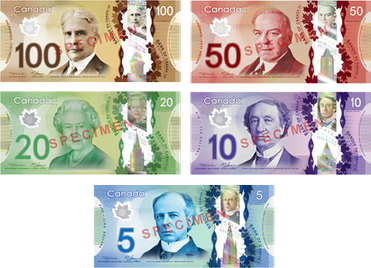
Tbf this is just this thing about the British society. I've lived here for 9 years and people are just not used to £50 notes, in several places I've had them refused(and I wasn't paying a £2 bill with a £50 note either, more like a £300 piece of jewelry and the shop just had a blank policy against accepting £50 notes, I've had this happen at petrol stations, at big stores, at small stores, people just don't like them). Where I'm from(Poland) high denomination banknotes are pretty common and no one seems to mind, I wouldn't have any qualms about paying for a 10PLN(~£2) item with a 200PLN(~£40) note, and I'm 100% certain that the seller wouldn't have any issue either. Meanwhile in the UK I was told by friends that if you're paying for £1 coffee with a £20 banknote you must be some kind of an inconsiderate dick. It's really weird to me.
Its nowhere near as bad as it was back in the '70s or so when some places devalued the other countries' Sterling by 10% before accepting it or flatly refused it. I've spend several eg Bank of Clydsdale £20 notes in pubs in southern England. I've also spent a fair bit of English Sterling up (proper) north with no problems.
It doesn't help that there are five or so different banks in Scotland issuing notes with different designs, so to spot a dud you need to really know your stuff.
I had a lot of trouble spending leftover Jersey pounds when i reached London. People didn’t even recognize the bills! I think a McDonalds ended up accepting them.
50 quid now is worth substantially less than 20 quid was when I was younger and 20's weren't weird then.
It just has this weird stigma. ATMs don't dispense them. I used to carry one around for emergencies, and people would comment on it (ooh, look at this flash prick, etc).
> You might be living in a bubble, fifty quid is much less than $100 and I see those notes all the time.
In nearly 40 years I can't think I've ever seen a £50 note, let alone spent one. €50 notes, sure, but Europe is backwards - I saw a €200 note once when buying a ferry ticket
> Getting currency exchanged before a trip? They give huge bills.
1990 called and wants its features back. I haven't been to an airport yet that didn't have an ATM. With the exception of the U.S. I rarely spend cash when I travel anyway.
> Buying a used phone or furniture from Craigslist? Are you going to pay with 100 twenties?
I can't imagine ever wanting to spend $2000 in cash. I had a builder do some work and it was about £800, a simple bank transfer and job done.
> New ATMs even ask you the breakdown of bill sizes you are want.
Do they? I haven't used an ATM since May (and that was in Hong Kong). Now that is unusual - most people do use cash, but then most people are more likely to want £5 notes from an ATM than £50.
Now the UK isn't as cashless as say China, but Cash is certainly not the norm - especially for anyone under the age of 60
Builders and other trades might want cash and even offer a slight discount for it, for some reason or other (cough tax cough).
I still like to use cash in a pub and I play pool every weds. This enables me to keep a pool of pocket cash which is handy. Cash is still king in some transactions and I'll miss it when it finally vanishes.
I blew a €200 in a bar in Switzerland once. A cash machine spat several out at me when I got my ickeys (forex) in ready for a week up a mountain with the boys. The barman didn't bat an eyelid when it was my turn to get a round in and I presented that beast to him. Mind you given the price for a beer which was roughly €10 for the local equivalent of the metric version of one pint, I was doing them a favour by keeping the paperwork to a minimum! That was about 15 years ago - God knows what they charge now.
> €50 notes, sure, but Europe is backwards - I saw a €200 note once when buying a ferry ticket
To add to your anecdote, on the Europe part, in a few years in Europe I've seen a few 500€ and 200€ notes (the last one a few days ago, used to pay a 1€20 coffee), and lots of 100€ notes.
> I haven't been to an airport yet that didn't have an ATM.
Those have terrible exchange rates. I’ve used an airport ATM once, and even then that was only because I realised too late that Switzerland wasn’t in the Eurozone.
The ones in British airports give terrible rates for Swiss Francs. My bank also had a terrible rate at the time. I got a better bank-like-entity since then.
On that occasion, I didn’t want to risk my (Halifax bank) card not working when I arrived — that particular card has been somewhat unreliable in the USA, and I still don’t know why, so I cannot be sure it won’t be denied elsewhere.
I have since gotten some better cards for international travels.
Heh, I think you might be trapped in the bubble of a country without free easy ways to transfer money electronically. Essentially every UK bank account offers free, instant transfers to any other account.
The only time I’ve personally had £50s in the past decade is when I was paid in cash for a software job by a somewhat dodgy client; that’s the association they have generally.
Can afirm. I'm a Brit with 48 years under my belt. A £50 note is a very rare beast and is almost never seen in the wild.
If it wasn't for the fact that I bought a car for about £1400 in fifties in about 1996, I have spent more $100 bills than £50 notes in my life. I have only visited the US on a few occasions for holidays.
£20s are more than enough for most things. They are not too big or thick so even £1000 is just about manageable in a wallet for a short time. Larger than say £200 at most is bank transfer stuff. We have had near instant bank transfers for years. To be honest I keep a cash float of about £100 but I am an older bloke and like to use cash sometimes. I could easily operate cashless for about 99.5% of the time. The number of transactions that I can't do with pay by bonk (NFC) or mobile banking is absolutely minimal. I only use cash in a pub out of habit to be honest.
I'd say it's about the same. With 10+ years in each country I see both about as frequently. Maybe 50 quid more often since atms give them out but can't recall a non casino USA atm ever doing hundreds
> can't recall a non casino USA atm ever doing hundreds
I've gotten them before when pulling out a few hundred dollars, but since most ATMs have a limit between $400-800, I guess it makes more sense to just stock them with small bills. I've gotten them before, but if I need more than $100 or so, I'll go into the branch so I can get exactly the denominations I want (e.g. I wanted $100s when I bought my car or for gifts, but I want $1s, $5s, and $10s for baby sitters and tips).
> You might be living in a bubble, fifty quid is much less than $100 and I see those notes all the time.
In 30 years, I don't think I've _ever_ seen a fifty pound note in person.
The Treasury noted in October 2018 that they rarely used for routine transactions[1]. You can see this difference in the value of notes in circulation. In the US, the vast majority (80.3%) of currency in circulation is in the form of $100 bills[2]. In the UK, there is double the value in circulation in £20s compared to £50s[3]. £50s only make up 24.6% of the value of notes in circulation.
I understand why you would say that, but that would be quite a big ask. There are only six bills, of which the design applies to 19 countries, and of which the United Kingdom is not a member. The bills feature fictitious imagery (at the time at least, as Tom Scott shows [1]) in order to avoid national bias.
For those curious as to what could have been, many of the 44 design proposals from 1996 [2] did feature historical figures.
The € bank notes do not have historical figures on them. Only the coins have historical or royal figures on them depending on the country that minted them.
If the UK had the euro they could put his face on their coins, but well... that's never going to happen anymore.
I wish it were also Rejewski et al. on the bill, the Polish mathematicians who originally cracked the Enigma about 8 years before they handed their work over to Turing.
* Designed the programming of world's first commercial computer (Ferranti Mark 1)
* Devised Turing Test, to test whether computer is capable of thinking like a huamn
* Got an OBE for his wartime services
* Inventor of Turing Machine. To this day, all stored-programme digital computers are modelled on this invention
* Built the machine that helped in the breaking of the Enigma code used by the German forces. This was used to decode 2 messages per minutes
* His work shortened the WW2 by atleast 2 years.
* Alan was a member of the team which decoded the 'Fish' cipher, which was used towards the end of the war by the German High Command to transmit messages between Hitler and senior officers in the field.
A few years before the Ferranti Mark 1, Turing was involved with the programs for the Mark 1's predecessor: Baby (1948) [1], the worlds first stored-program computer, which as you mentioned was based on his Turing Machine (1936).
I learned about Turing as part of Baby's and the Mark 1s history first before any wartime efforts as I did my BSc at the University of Manchester. Also only later would I realise the honour of Tom Kilburn handing me my degree when I graduated and having nice chat with as well.
Would they have? I don’t pretend to be an expert on plausible alternative history, but as the USSR reached Berlin before the UK/USA/French forces, I can easily imagine that without Turing’s work the Iron Curtain would’ve been either through the English Channel or along the Rhine, while the Pacific war would’ve gone the same way.
The primary difference that Enigma made was shipping to Russia and the UK. It’s likely it would have hurt both, but once the escort carriers started showing up in the Atlantic, the ability to operate subs would have gone away anyways.
In the pacific, not a chance. The soviets rolled the Kwantung army at the end of the war, but that’s because it was stripped of all it’s assets well before the soviets showed up, as the Japanese desperately tried to re-enforce islands that the Americans later isolated and island hopped and starved into submission by virtue of the “Big Blue Fleet”. The atomic bombs may not have ended the war, but ending the war with a invasion or a starvation blockade required a massive naval armada, and the Soviets had nothing. The Brits barely were able to operate in theater.
Engima’s impact on the battlefield was much more muted then the submarine war especially compared to Purple / Hypo / Market Garden and The battle of the Bulge where both lulled into disaster by the lack of enigma intelligence. It did play a positive role in Africa and on D-day (where it was most useful in revealing fortifications on the beaches), but it was not decisive there.
Engima never made it’s way to the pacific. In the pacific, Corel Sea, Midway and the assassination of Yamamoto where all predicated on decrypted secrets, but this was a completely separate effort from Bletchley Park.
No, it was just ordinary police and a court conviction that did that. The intelligence agencies likely knew about his orientation long before and did nothing about it - if anything, it was something that could be used to control him.
Modern computers aren't really based on the Turing machine idea any more than they're based on the Lambda calculus, and I think it's questionable that the early computers were intentionally modelled on it.
The US needs some updating as well - see the kerfuffle about trying to get Harriet Tubman on the $20, which Trump nixed, because racism. He wanted to put her on a reissued $2 bill, but I'm not sure there's an appetite for that. Symbolism matters in this case, and Trump is clueless.
This man broke the enigma code, which helped win the war against the evil Nazis. He built early prototypes of the modern computer.
Your computer might not be as powerful today, or even exist without his inventions. Funny how alt right/nazi idiots are using later versions of his technology to type out comments that seem to imply he's on the note simply because he was persecuted.
But it's easy to see why Nazis hate him. He's not only gay, but he broke their "unbreakable" code. Maybe they'd have gone further in their war if it weren't for him?