It's hard to believe that it's been over 50 years since humans have been outside of low earth orbit. It's like we sprinted forward so fast, going from horse drawn carriage to space flight in a generation, only to get frightened and recede back from the highest point, never to go back.
Granted there has been an enormous amount of innovation in the last 50 years, but by some accounts we've been going backwards. Humans are no longer capable of mach 3 flight, or making Roman concrete.
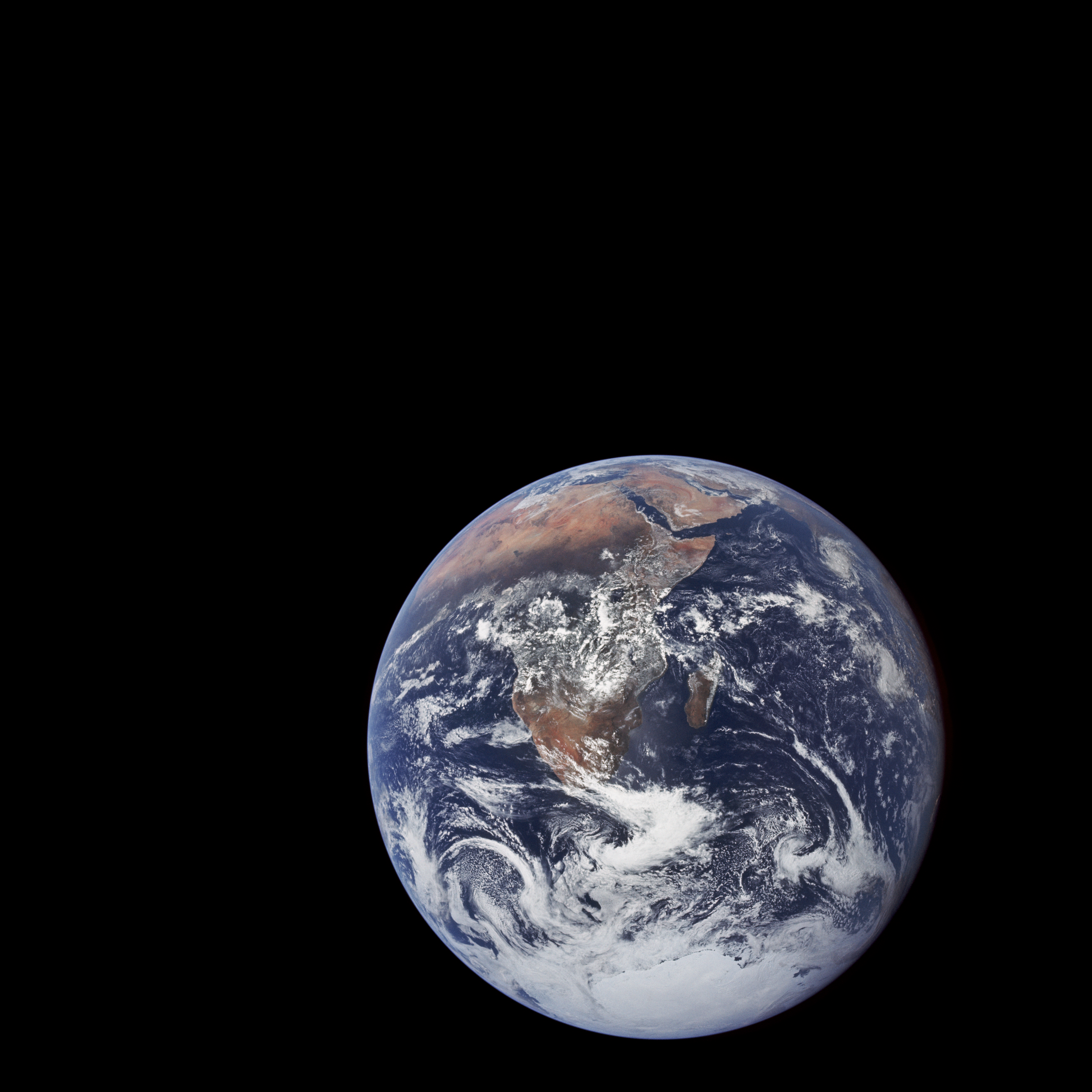
I think we assume that technology will keep progressing. We assume Moore's law will continue into the future and we forget that there are people behind the progress. The technology that produced those pictures are gone, we might be able to take ones like them again, but never with the same rockets and never with the same photo-chemical processes. Progress is fragile, not inevitable and everything we have can be lost in a generation just as easily as it was made.
You really need to take the power and "reality distortion effect" of propaganda during the Cold War into account.
Massive projects were started without much rational sense just to beat the other side in an imaginary race (and a very concrete military race). What's the point of landing a man on the moon, if the technology to do so was so rushed and held together by duct tape that it wasn't useful for anything else? What's the point of the Space Shuttle if launches were more expensive than disposable rockets? What's the point of the Buran, if the Soviets didn't feel like they need an answer to the space shuttle "just in case", even though they couldn't see any point in the shuttle design (except as a nuke carrier)?
Etc... etc... the list goes on for both sides. I rather have slow and steady progress that actually makes economical and scientific sense in the long run.
PS: I thought the secret of Roman concrete had been cracked long ago (a certain type of volcanic ash)? But it's just not economical to produce large quantities since modern sky scrapers are not expected to "survive" for thousands of years anyway (and AFAIK the Romans didn't know much about the special properties of their concrete either, it more or less was a "happy little accident").
> What's the point of the Space Shuttle if launches were more expensive than disposable rockets? What's the point of the Buran, if the Soviets didn't feel like they need an answer to the space shuttle "just in case", even though they couldn't see any point in the shuttle design (except as a nuke carrier)?
Rather than nukes, I always thought the main advantage of the Shuttle was the ability to bring things back to Earth. Which it did, a few times:
When then Shuttle was proposed, this was one of the main selling points. Having used it just 4 times over 133 missions... Well, that's not what was envisioned.
AFAIK the Russians were mainly concerned about the ability of the Space Shuttle to quickly change its orbital plane, combined with the planned high frequency of flights (which never happened though) and high cargo capacity.
Put a few nukes on the Shuttle, and you can drop them anywhere in the world with much less warning time than intercontinental ballistic missiles. At least that's what I read about the reasoning of the Russians building their own shuttle, because when they ran the numbers on the Space Shuttle they concluded that a "civilian use" didn't make much sense.
Changing orbital plane requires delta V, and the Shuttle had barely enough to make it to LEO (the highest it ever went was servicing the Hubble).
Cargo capacity... Not that much really, since you're carrying yourself a whole lot of orbiter already. It had a large volume in the cargo bay, and the mentioned ability to retrieve things in that cargo bay.
But yes, DoD/military influenced the design of the Shuttle. It just turns out they never used the capabilities they requested. And so you end up with a craft that makes little sense for civilian use, except for the building of a massive space station in orbit and eventual servicing of satellites.
From some distant memory the dimensions of the Space Shuttle cargo bay was specifically matched to accommodate the launch and servicing of the Hubble Space telescope. I'm not sure which design drove which.
> without much rational sense just to beat the other side
Assumes that just beating the other side was not a sufficient rational motive. Which, given that the threat both sides faced was "you and your way of life will be utterly obliterated", is a pretty irrational criticism.
What's the point of <X>, if <something we only learned by doing X>? There's tremendous hindsight bias in criticising even the Shuttle program on the basis of what we know now, while disregarding the value of everything we learned from doing it.
Even copying another country's technology on the basis of speculative military applications may not be irrational, unless you're somehow privy to all the knowledge that was available at the time when those decisions were made.
The remarkable MAD doctrine itself can be criticised as inhumane or insane, but hardly irrational. It's a triumph of rationality and a counter-intuitive application of game theory, the iron laws of mathematics elevated to places where we really would rather see common sense and humanity prevail.
I think you are suffering a bit from survivorship bias here. Way less than 0.001% of Roman buildings are still standing and the ones that remain have been continuously maintained over the centuries. If humanity will keep maintaining the White House for centuries it will look just as good in 4021 as it does today.
The White House is not a modernist / postmodernist building that was designed with planned obsolescence in mind, so I'm not entirely sure why you've used it as an example. In fact, it's a perfect example of a beautiful neoclassical landmark that was intended to inspire and last through the ages.
Survivorship bias is always brought up in these discussions, but I believe it to just be a cop-out. Take a look at any well-preserved medieval / renaissance / early industrial era city in Europe (Bruges, Edinburgh, Venice). They are all absolutely gorgeous, even the buildings used historically by the lower classes (ones that were not even built with longevity in mind).
No, something flipped around the 1920s, and architecture, along with our whole societal philosophy around it, has clearly changed. I'd argue that it's for the worse.
> In fact, it's a perfect example of a beautiful neoclassical landmark that was intended to inspire and last through the ages.
I'm going to go out on a limb here, and guess that you've never been to the White House: it's a mildewed, creaky mess that was gutted twice (once by war[1], again to prevent it from collapsing under its own misdesign[2]). It undergoes constant, active maintenance, and is not intended by any means to "last through the ages."
But to get to the actual point: the neoclassical style is built on a historical lens. It takes classical architecture on face value, as it was in the 18th century (i.e., weather-washed and in ruins). Its appliers wanted to promote their interpretation of classical greatness, which corresponds in no particular way to the actual greatness of cultures in the classical period. The Romans would have laughed at our neoclassical use of blindingly white marble[3].
Needs changeover time. Thick stone walls can provide insulation, but their hell on WiFi etc.
Growing up in a 200+ year old building you find a lot of architectural designs and modifications that don’t fit with modern usage. Pre AC maximizing summer cooling involved maximizing airflow where now we want maximum insulation. Before central heating we wanted chimney’s everywhere. And before wood stoves we wanted giant fireplaces everywhere. Even central heating has gone through several iterations, many different radiator designs for steam/water, central air, and now a zigzag of pipes underfloor.
Very old buildings may look nice, but they aren’t inherently better.
> Very old buildings may look nice, but they aren’t inherently better
I never said they were. I only said that they were built to last and that they were infinitely more aesthetically pleasing because we actually gave a damn about these things as a society. Now we don't.
Old buildings can be upgraded (I should know, I live in one, and have both functional pipes, insulation, heating, and Wi-Fi). So let's upgrade them, and let's ALSO ensure that whatever we build today includes not only modern amenities, but are also objects we can be proud of leaving as a legacy to future generations. Just like our ancestors did for literally millennia.
> we actually cared about this things as a society
No, the buildings that survived are generally more aesthetically pleasing, most old buildings where shacks. Walk around an old plantation for example and the slaves quarters didn’t survive. Search around for some original outhouses and you realize what survived isn’t simply representative of what was built.
It's mostly not survivorship bias, actually, and the ones that remain haven't been continuously maintained over the centuries. Many of the ones still standing today suffered from centuries of neglect, damage in war and rebellion, and even were actively looted for materials to build other buildings from. Others just got gradually buried by floods (or volcanos, etc) and are intact underground.
From the first wikipedia paragraph, I don't see anything wrong with building things so they'll look cool a) when they're maintained and in use and b) when they're badly maintained and crumbling. I'll take 'Ruinenwerttheorie' buildings over brutalist concrete piles that look disgusting the day they're built and worse as they age.
The 3rd Reich had a lot of problems, but they had some good aesthetics (Huge Boss, etc). To ignore that, and shun a whole realm of aesthetics because it was appreciated by The Devil, is a waste and a poor strategic move; you're abandoning the beautiful elements because they had the misfortune to be mixed into a dark brew. It's an artistic tragedy, and a poor political move, putting you in a similar spot to the 3rd Reich themselves with regards to their ideas about 'degenerate art'.
The height of technology, and we cloak ourselves in ugliness and mediocrity, not daring to build anything beautiful. What a fucking waste. The sorts of small-souled people who build modern western identikit cities don't deserve to go to the moon.
I think the point is that it takes a sort of hubris that's quite typical for autocratic regimes to show off to the rest of the world - and future generations - with gigantomanic architecture.
IMHO a healthy society should be "above" this sort of stuff.
What we have in our oh-so-humble and "advanced" society is the children of corbusier making horrendous buildings that make the people with no choice but to live in them miserable.
Because I know a city made of buildings like the above is far more conducive to human dignity than a grid of "humble" glass boxes.
Should we all be living in and surrounded by identikit, homogenous apartments? Except for the architects and the rich, of course; they get to have centuries-old country mansions to flee to.
It isn't humble to humiliate people by making them to live in concrete and glass cages.
I don't quite understand how y'all came to the conclusion that I want people to live in ugly glass and concrete blocks :)
I do doubt however that many people today would want to live in genuine old buildings with the outhouse toilet across the yard. It's more likely that they want to live in a modern flat built into the hull of an old building.
Instead of showing off to the rest of the world, we should ensure that people feel oppressed and demoralized by their every day surroundings. That'll show those autocrats!
Brutalism was adopted by the Soviets, who were also pretty oppressive.
I'd rather live in a beautiful building than a concrete square. The idea that people should live in purely functional environments with no room for beauty or art is a purely modernist idea.
I might be a minority opinion but I think brutalist architecture can be beautiful. My local library (https://www.yelp.com/biz/port-washington-public-library-port...) is quite brutalist but is also one of my favorite libraries. Its reading room alone (the library sits up on a hill and the reading room has one wall of all-glass-and-concrete which looks out onto Manhasset Bay) is amazing.
Taste is individual, but I just don't understand how you could find a heap of concrete slabs to be beautiful. To me, beauty is life-affirming, and brutalism is the physical embodiment of a philosophy that denies life in favour of rigid functional structure. It's the physical representation of kafkaesque bureaucracy.
I’m glad you’re respecting taste, especially when you’re throwing such anthropomorphological argument against it ;)
I’m not sure why there is such a significant aesthetic difference between cutting stones and stacking them (masonry architecture) and filling the exact same form with concrete, especially when the latter is usually far more robust and thus, safer (read: actually life-affirming, by being neither flammable nor easily collapsible, if designed right) and also permitting structural forms that are simply not possible using any other medium
Architecture follows philosophy. Skyscrapers (internationalist style) and large curved glass buildings (modernist style) have the same core philosophy as neoliberalism, for instance. Brutalism came about as an explicit rejection of aesthetics and "higher purpose" to building facades - an idea deeply rooted in materialist philosophy, hence its adaptation by the Soviets. The grandparent comment demonstrates this perfectly: "IMHO a healthy society should be "above" this sort of stuff". Your argument to building materials is also an example of this - while it's true, it is reductionist; living in a concrete jungle is not better than living in a wooden fishing village just because the materials are less flammable.
The philosophy of architecture isn't really a "anthropomorphological argument" when architecture exists for humans, at the behest of humans, and represents human values. The idea that a building is just a box that people exist in is itself a philosophical position, one that is exemplified by brutalism, and one that I and many other people are opposed to.
Interesting. Very holistic. Which is to say, not very concrete. Wink.
Did you follow the link I posted a few comments up, the "nine brutalist wonders of the architectural world"? Explain how those exemplify "just a box that people exist in"
> Interesting. Very holistic. Which is to say, not very concrete. Wink.
Very modernist thing to say. I suspect we have very different philosophies, and I have a strong distaste for modernism, materialism and reductionism in general. You can't quantify the things that actually matter in your living environment beyond the bare essentials of survival, so of course the concept is not concrete to you if the only things you value are the things you can measure.
> Explain how those exemplify "just a box that people exist in"
Yes I saw the article. The few that actually were buildings instead of sculptures (barbican, bank of London and South America, geisei library and the cathedral) are hideous. The cathedral is the least ugly because its at least not a raw concrete facade, but as far as cathedrals go it has to be the first I've seen that left me with no sense of awe whatsoever.
For what it’s worth, the space race along with the desire to build up missile technology in general are the reason we have computers today as we know them. Not many people outside of the space and defense industries were willing to shell out buckets of cash for a single transistor.
"It is durable due to its incorporation of pozzolanic ash, which prevents cracks from spreading."
Third sentence in the Wikipedia article. Later:
"The strength and longevity of Roman marine concrete is understood to benefit from a reaction of seawater with a mixture of volcanic ash and quicklime to create a rare crystal called tobermorite, which may resist fracturing. As seawater percolated within the tiny cracks in the Roman concrete, it reacted with phillipsite naturally found in the volcanic rock and created aluminous tobermorite crystals."
such a nihilistic view has little ground in reality
> been outside of low earth orbit
we stopped pushing that frontier because we've been there and found it dull and empty, as a matter of fact, we decided zero g experiment were more important than playing with regolith, and build a freaking human habitat in the void to support that endeavor. beside, we've got regolith here on earth now, we can experiment on it in the commodity of our backyard if needed be.
> mach 3 flight
except the routine space launches that ship scientist back and forth from the space station, going through literal plasma on the descent leg.
> Roman concrete
this has just been widely romanticized, we don't use that because it's incompatible with fast building processes requirements, is too heavy for large structures and it's hard to dismantle when a structure is no longer needed or need renovation.
sure, some other stuff one can cite as having reached an apparent sub-optimal minima, like average speed of travel, but that's not because we're backward, it's because we're learning to take care of our own environment. slowly, but we're getting there. just because the tradeoff are different it doesn't mean that a golf id3 is just worse than a bugatti eb110 or a recess from peak technology.
Your last point resonated with me. An extremely boring electric car that makes some significant leap in affordability, efficiency or whatever can be the thing that brings our entire society forward and literally saves it.
If anything you can argue that the latest Bugatti with a slightly larger engine is moving us backwards by the waste of resources (in design, production and use).
Peak technology right now is not the big sexy machine, it's whatever makes the good stuff boring for the masses.
The primary purpose of ISS is to be a jobs program, not scientific experimentation. The Russians are involved specifically to keep their engineers from going to work for hostile states.
They're learning all kinds of things by seeing how plants grow in microgravity and more recently how 3D printers work in the same. It didn't need to cost a trillion dollars for that, but now that it's there, we might just get over a trillion dollars worth of science out of it.
But still, we're to the point where not a state, not a government entity, but a rich, bored dude is sending people into space as a viable business model
Thinking our space tech is going backwards is severely myopic
Humans are capable of Mach 3 flight. It's just a "latent" capability. Something we could do but is not currently cost-effective.
> The technology that produced those pictures are gone, we might be able to take ones like them again, but never with the same rockets and never with the same photo-chemical processes.
You can never step in the same river twice, and we are all mortal. This is just a statement about the passage of time.
> Progress is fragile, not inevitable and everything we have can be lost in a generation just as easily as it was made.
This, on the other hand, is important, and why it's important not to let people wreck it by lying about everything.
Worth questioning the "whig view of history" backwards as well; a lot of what we call progress had very large costs for certain groups of people at the time and made their lives worse. Or got them killed.
I think it’s a case of picking the low hanging fruits once the technology is unlocked, then moving on.
We have the same not only with space but with everything.
Steampunk is essentially the feature we never had with advanced enough mechanical machines. Somehow we sprinted towards harnessing the energy of the steam stoping short from coal powered AI robots but was that the case? IMHO what happened is, we exploited the feasible part and moved on.
The same with space. With the science and tech we harnessed so far, it’s simply not feasible to do more than what we have done already. With the advancements made in recent decades, some more stuff might have moved within the range of feasible but nothing revolutionary. We are not going to the nearest star anytime soon and that’s not simply because we lost interest in it. The best we probably can do in human travel is Mars.
Okay, I came here to talk about how the images are a bit soft and a quick, subtle pass of Richardson-Lucy deconvolution restores some detail (and enhances the film grain, that's a plus for me but some people may find it a bit too much -- it is still there in the pictures though).
And then I read your comment and you totally throw me into a Wikipedia rabbit hole with the Roman concrete... Speaking of which, what do you mean we can't make Roman concrete nowadays? Wikipedia even says that there are corporations and municipalities looking into it as a viable, environmental-friendly, long-lasting alternative to regular concrete[0] !
It's essentially an old meme; the exact details had been lost, since the technology was not in continuous use and no written record survived, but the footnote on Wikipedia details its reconstruction. This great paper: https://pubs.geoscienceworld.org/msa/ammin/article/98/10/166...
Essentially it relied on volcanic ash from specific locations, and they forensically traced those locations.
Right, that's the impression I got from reading. And it looks like we have regained that technology, which is what threw me off the remark. Will take a look at that paper, however I'm totally a stranger to most geo-something sciences, just a regular software engineer here (with quite a bit of scientific curiosity though).
> Humans are no longer capable of mach 3 flight, or making Roman concrete
We have plenty of aircraft capable of mach 3 or faster just not for commercial purposes, and most modern concrete is superior to Roman concrete in most dimensions specifically cost (not to mention its modern mythos is completely based on a single study published in American Mineralogist).
The supersonic passenger flight thing is the one I have to really chuckle at. Nothing against the work being done in this area--hey, not my money. But effectively you have lots of folks, who probably mostly fly coach, super-excited that maybe one day CEOs and high-end lawyers will once again be able to fly from NY to London to have lunch, shake hands on a deal, and be home in time for dinner.
The passenger flight thing is the one I have to really chuckle at. Nothing against the work being done in this area--hey, not my money. But effectively you have lots of folks, who probably mostly take trains, super-excited that maybe one day CEOs and high-end lawyers will be able to fly from NY to London.
Yeah. If there's good train service, it probably makes more sense to take the train. But if I'm flying through a city to get to another city, switching transportation modes can be a pain. e.g. Normally I'd take a train from (downtown) Manhattan to (downtown) Philadelphia. But if I'm flying into a NYC airport on my way to Philadelphia, that's a terrific hassle especially with luggage.
Technology has not regressed since the 1970s though. We have the latent capability to go any time we want, it’s just very expensive and there’s no point.
Actually doing it is important. “I can go to the moon anytime I want” stops being true after a solid generation of not doing it. There is institutional knowledge in doing something in the present world. Further, specs and documents are nice, but rarely sufficient. A famous example is the F-1 engine. Every one of them was made off spec and if you took the factory drawings alone you would never make a working engine. You need builders who understand the design and modify it.
It’s all possible to do this, but the longer you wait to do it again, the more factors change and the more work it will be.
NIF exists to keep a team of nuclear bomb experts warm in case we need them. It isn’t to make a power plant or to make new bombs; it’s just there to keep the kettle warm.
Anecdote: I work at a physics project. When the PI asked for 200 million USD to build a new machine after 20 years they were awarded 3 millions USD to do an upgrade to the old machine. The funders are making sure that a team can still be assembled and get shit done under the PI’s leadership. If the upgrade goes on time and on budget then the new machine might be on the table.
The same thing is going on with many physics projects. Small prototypes get funded. “If you can make that and it works, then we’ll talk about the next step.” It’s slow, but it’s safe.
For SLS a group looked into making boosters powered by modernized F-1's... Turns out a lot of knowledge about welding them had been lost. They managed to get an old unflown F-1A to work, but it's a bit unclear how much they managed to do with the new design, the F-1B. Wikipedia[0] has a few details and some links, but it falls short of telling the end fate of this effort.
Obviously, the F-1B booster wasn't picked for the SLS and they went with the improved 5-segment SRBs[1].
> Actually doing it is important. “I can go to the moon anytime I want” stops being true after a solid generation of not doing it. There is institutional knowledge in doing something in the present world. Further, specs and documents are nice, but rarely sufficient. A famous example is the F-1 engine. Every one of them was made off spec and if you took the factory drawings alone you would never make a working engine. You need builders who understand the design and modify it
And I'd argue that's exactly why I'd argue the fundamental approach of the 60s/70s rocket engineers was fundamentally flawed. It was a vanity project and so it died after vanity was satisfied.
The assembly line and standardisation approach SpaceX takes is much superior and much more sustainable.
I agree. Importantly Space-X’s engines are actually cutting edge. They are the best performers man has made, so we’re not walking backwards. However, that progress was not guaranteed and if we stopped all space travel for fifty years there would need to be another monumental effort to relearn how to build rockets.
I play with CRTs as a hobby. It’s popular these days, but it will never be popular enough to manufacture another CRT. The last assembly lines closed a decade ago. The physics knowledge is there, and electronics have gotten better, but it would take many iterations to make a trinitron equivalent in another 20 years. The people who understood the magnetics (ie how horizontal output transistor and flyback transformer characteristics interacted with the impedance of the steering coils) are dead or retired. The same for the experts in mask manufacturing. We can figure it all out again and do it better than ever, but it would be a lot more work than if we had continued making them.
Again, it’ll never happen because they’re too big and require too much material compared to other display technologies. It’s just interesting how fast they disappeared when they were an integral part of human society for nearly all of the 20th century.
I agree that there’s probably not much value in just retreading the old specs, but I’d argue that just having the knowledge that it has been achieved in practice still puts you ahead of the engineers in 1961, and that the intervening decades of progress put you even further ahead.
There’s no reason to think that an equally well funded greenfield effort couldn’t land on the moon from a standing start within a decade; it’s not like we’re living in the shadow of an ancient advanced civilisation with no present day industrial capacity.
No and I agree. Saying that we’ve regressed in rocket science or concrete in any capacity is a fantasy. However, if things go stale then we could be forced to invest a lot of money to discover things we’ve already discovered.
> I think we assume that technology will keep progressing. We assume Moore's law will continue into the future and we forget that there are people behind the progress. The technology that produced those pictures are gone, we might be able to take ones like them again, but never with the same rockets and never with the same photo-chemical processes. Progress is fragile, not inevitable and everything we have can be lost in a generation just as easily as it was made.
It's good to be aware of our blindspots. The idea of progress as a monotonically increasing upward trend is a very modern and Western perspective. It's not inevitable.
People have been hiking to the top of mount Everest for a while now, but you still can't ask an Uber to take you there.
Because there isn't much worthwhile to do there, the interesting thing is going there, not being there. At the moment. When/if it can be done for cheap and on the regular, there might be stuff to do.
From the lengthy blog post under the images, it'd seem he used those archives. I have the impression that I've seen these pictures as TIF files instead of JPGs somewhere (the Internet Archive perhaps?), but I can't remember precisely now. Maybe the author used those, as I imagine they'd give a bit more leeway and flexibility in a restoration effort.
I was going to post exactly the same thing. It's such an understated way of phrasing it and a really beautiful photo. I wonder how Collins felt? There's a quote from him on the page, but it's more about the photo rather than himself. Surely that's been discussed...
It's a truly amazing book. It's easy for authors to romanticize spaceflight or to write a dry technical manual. Carrying the Fire does an incredible job of splitting the difference between the two extremes.
I was thinking the meaning of the caption was ray tracing light through the lens from a single point on one side. I suppose you could stick your head in a fishbowl that is sitting on the ground to get the same effect, as long as there are no planes or manned spacecraft directly above you.
Technically you can do that with a planar lens if you stick your eyeball onto the lens.
I love this quote from Edgar Mitchell (Apollo 14) on seeing Earth from the Moon:
You develop an instant global consciousness, a people orientation, an intense dissatisfaction with the state of the world, and a compulsion to do something about it. From out there on the moon, international politics look so petty. You want to grab a politician by the scruff of the neck and drag him a quarter of a million miles out and say, "Look at that, you son of a bitch."
I wonder how we could get more people to experience this effect... Something like what Stewart Brand did by pushing for and publicising the first whole earth picture (in part via the Whole Earth Catalog) but more for the internet age.
I was toying with an idea of a site called "Get Some Perspective" where you'd start off with a FPS view and as you scroll you gradually zoom out, eventually to the whole observable universe. You could send this link to people if they're being short-sighted, callous, etc and hopefully instill a bit of the Overview effect in them...
I think you're toying with the dangerous Total Perspective Vortex [0] as described by Douglas Adams:
The Vortex is now used as a torture and (in effect) killing device on the planet Frogstar B. The prospective victim of the TPV is placed within a small chamber wherein is displayed a model of the entire universe - together with a microscopic dot on a microscopic dot bearing the legend "you are here." The sense of perspective thereby conveyed destroys the victim's mind; it was stated that the TPV is the only known means of crushing a man's soul.
This will crush your soul if you consider you are insignificant, but let me help.
The entire universe is ENORMOUS and we are but tiny specks. But the same God who made all of that, made us, too. And that same God knows us by name and wants to have a relationship with us.
I can get just a tiny grasp of the power of that sight just by looking at the photos, and can't imagine what would be like experiencing it in 1st person.
This brings the hope that one day when every human would be able to experience it, we'll create a utopistic Trek-ish reality in which people suddenly become less selfish and put the common good above idiocies such as nationalism or the pursuit of immense wealth at the expense of others.
Hopefully one day seeing the Earth from orbit will become sort of a rite of passage for kids.
I'm sure it's hyped up to the point that if you went up there, expecting a cosmic experience, having imagined and simulated it a million times, you'd be disappointed by the reality.
I used to think that about the Grand Canyon, then I went. Nope, it's just as impressive as they say being there experiencing it in person vs looking at all of the videos/images available. Seeing an image that required a special lens to take it all in looks nice. Standing in the same spot the camera was is a completely different experience when you have to turn your head left/right to see the same thing the image does. Anyone that says different has not actually taken the pepsi challenge
Missing is the Voyager 1 image looking back to Earth from 4 billion miles, the one referred to by Carl Sagan as "the pale blue dot, a mote of dust suspended in a sunbeam". It doesn't have the resolution these images have but it's impact on our civilization is over-whelming.
I once saw a video (reenactment but original voices maybe?) of how one of these images was taken. How the earth appeared over the horizon and they scrambled to find a camera or so. Anyone knows which video I'm talking about and could help me find it?
- adjusting the black point until the background of space appears truly black"
These shots are beautiful, but is making the background completely black really doing reality justice? In our unfortunately light polluted night sky we can barely see the stars, but shouldn't the astronauts see the earth within a shimmer of billion stars? Or is the source material not showing stars due to a lack of exposure?
> In our unfortunately light polluted night sky we can barely see the stars, but shouldn't the astronauts see the earth within a shimmer of billion stars?
No, you have to be in the night side, or looking into the void (no Earth surface visible, definitely not the Sun in sight, not any part of your spacecraft being shined upon) for your eyes to adjust to the darkness and then you get to see the stars. Being near the Moon, I'd add "no moon surface" to that list.
> Or is the source material not showing stars due to a lack of exposure?
I'm not sure there... Film behaves differently than image sensors. Maybe if we had access to the negatives you could do some chemical magic to bring in detail. I don't know how hard/destructive that could be on the negatives, as film isn't a medium I've ever really used. Grew up in the 90's with a few film cameras, but digital took over before I had the chance to seriously get into photography and was also far cheaper (so, easier to pick up as a hobby for a teenager). Now I'm into digital image processing and that's a totally different beast on its own.
A bright moon surface and fully lit Earth hanging in the sky is also a sort of "light pollution" for the human eye ;) (at least it will cause the pupil to close and let less light through, tuning out the dim stars, same effect why there are no stars in the moon photos). Of course I haven't been to the moon so far and can't really know what the sky actually looks like during "moon day" :)
So stars are not visible from space? I'm assuming not because they're not in the pictures, but because there are no pictures of just stars from space, which I assume would be a point of interest for any astronaut. That is weird, and I wonder if almost every single sci-fi scene in space should have no stars as well.
Stars are visible in space but the Earth is so bright that if you expose it properly, the stars are underexposed. It’s basically the same reason we don’t see the stars in the daytime: the sun is much brighter.
Right but does that mean astronauts don't see stars because it's always "daytime" in space? If we can see the Milky Way in the night sky of remote places away from cities, then the atmosphere must be playing a huge role in allowing us to see stars. I'm just wondering if those night skies are also visible in space, perhaps from the dark side of the moon.
>With great foresight, NASA equipped the astronauts with some of the best cameras ever made — specially modified Hasselblads, with Zeiss lenses, and 70mm Kodak Ektachrome film.
Amazing article and incredible pictures, but this one line has me scratching my head:
"Only 24 people have journeyed far enough to see the whole Earth against the black of space"
The Apollo missions from 8 through 17, with the exception of Apollo 9 (LM test in Earth orbit), all reached lunar orbit, even if 8, 10, and 13 didn't actually land. Each carried 3 crew members. Doesn't that make 27 people?
As a kid, I really wanted to be an astronaut. I didn't make it, although I did go to Space Camp. It's mostly something I don't think about anymore, until I see pictures like this - looking at the entire planet just floating there in space does something to my brain. I hope space tourism will become accessible to non-billionaires in my lifetime!
Given the scope of the universe, and aided by the perspective of photos like these, many would certainly describe this idea - that life has only ever existed and will only ever exist on Earth - as "unbelievable".
Keep in mind that you are not seeing a complete "half" of the earth in this picture. As your distance increases, the effective horizon encompasses more of the surface. Only at infinite distance would you see exactly half of a sphere (mathematically speaking).
Try taking a picture of your globe closer and closer to the surface and watch as less of the surface is visible in each.
You're right! But with my globe at home, and that site you listed, at the same angle I can clearly see part of India and Australia, it's weird that they don't seem to show up in this picture.
I cried a little at the the shot of the lander and earth from the command module, the thought of every single other human in the same frame is just too much.





Granted there has been an enormous amount of innovation in the last 50 years, but by some accounts we've been going backwards. Humans are no longer capable of mach 3 flight, or making Roman concrete.
I think we assume that technology will keep progressing. We assume Moore's law will continue into the future and we forget that there are people behind the progress. The technology that produced those pictures are gone, we might be able to take ones like them again, but never with the same rockets and never with the same photo-chemical processes. Progress is fragile, not inevitable and everything we have can be lost in a generation just as easily as it was made.