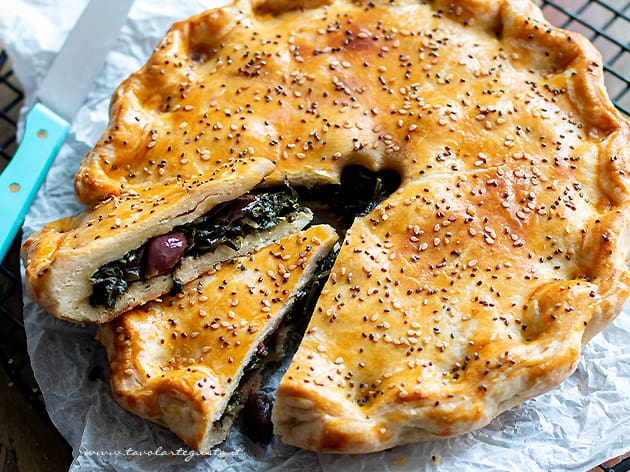
Everyone here is trying to be way too literal to "gotcha" about what sauce is.
I am Italian, and you need to define these things way more off feel and appearance than some scientific definition of "sauce" that you just made up.
Regardless of whether "pizza sauce" is cooked or not, you look at and you know it's sauce. It's near-puree consistency, with all the ingredients having been blended together, you could spread it easily with a spoon.
Look at that picture, those are clearly crushed tomatoes that were very recently a full tomato, not like a canned "crushed tomato" you would get in a store that's already like 95% of the way to sauce consistency.
You could not spread those around evenly or easily with a spoon. It's not a sauce. It's crushed tomatoes, with salt, oregano, and olive oil.
If you want to "gotcha" go with the fact that the vast majority of these would not be called "pizzas" by anyone in Italy - as mentioned by
@elrond89.
Again by feel - you look at a big piece of woven/folded bread with some other ingredients - does it feel like pizza to you? Probably not. Most of those would be called "focaccias" or similar.
Looks similar to a standard, default-toppings New Haven style pizza, to me, which also features a coarse-crushed-tomato sauce and not much else. In either case I think you point at one and tell the average person on the street—especially among an English-speaking audience, as I suppose this article is aimed at—"look, this pizza has no sauce" and they'll look at you funny and think you're playing some kind of joke on them, because it sure looks like it only has sauce. Listing the ingredients the way the article does just makes that seem to be even more true, since it's practically a recipe for pizza sauce.
For the second time on this thread, its because it’s not blended up into sauce! The ingredients are placed on separately and the consistency is not that of sauce! Any more than a bag of sugar next to a carton of eggs is a cake batter!
> practically a recipe for pizza sauce
You're saying it yourself but not absorbing it. The ingredients themselves do not make a final product, in the same way that a fajita plate is not a burrito which is not a quesadilla.
I'm looking at the picture, and that sure looks like a valid sauce consistency to me. A coarse sauce, but a sauce. Again, it looks like (I mean, exactly like) what's on other sauce-mostly pizzas that people definitely say have sauce on them. shrug
Also: so you're telling me they put the crushed tomato on, then put salt and oregano on top of it, rather than stirring those into the crushed tomato? I guess if the oregano is fresh and goes on after the bake, but I'm not seeing that in the photo. One way or another, it's settling in to the sauce.
Pizza sauce, being (in its minimum form) so very simple and uncooked, is a weird case. The ingredients themselves do make the final product, for that. I'd still call that a pizza sauce, and again, I think you'd get a lot of weird looks showing that photo to people and telling them it lacks sauce. If it's not sauce, then lots of more-normal pizzas "don't have sauce" either. Like, if you just had salted crushed tomato, not even any oregano, on a pizza, I would absolutely say it's got pizza sauce on it. Oregano's common, but not required. It'll taste weird enough without any salt that I might start to reconsider then, but only then.
Well, 1) that sure looks like a tomato sauce on top of that bread, and 2) all you do to turn crushed tomato + salt + oregano into pizza sauce is stir slightly.
[EDIT] I'm not trying to be a dick about this, I was just really surprised to read that description, coupled with the photo above it. "no tomato sauce" goes on to describe its toppings as exactly what one might mix to get a pizza sauce
You don't need to (pre-)cook pizza sauce, though. The thing that struck me was this article about pizza claiming that the exact things you put in pizza sauce, being practically the only things on a piece of flatbread that the article is claiming counts as a style of pizza, is compatible with the article's claim that it doesn't have tomato sauce on it. I mean, either most pizza doesn't feature tomato sauce (because pizza sauce doesn't count, for some reason), in which case why mention it, or otherwise I'm pretty sure this does too.
"Tomato sauce" is a very ambiguous term, and pizza sauces are not necessarily cooked. Just open a can of crushed tomatoes (or crush them yourself) and stir in some salt, olive oil and whatever other seasonings you want (garlic, oregano, etc.). That is pizza sauce. That's what it looks like in the picture being talked about.
Italian here. Of those in the pictures only a couple are really considered pizza by us.
Pizza must always be a dough with a raised border and something on top.
Also we really care about how you cook it. Real good pizza is only cooked in a brick oven with timber, everything else is good but not real pizza (is usually lower quality)
The spaghetti tree hoax is a famous 3-minute hoax report broadcast on April Fools' Day 1957 by the BBC current affairs programme Panorama. It told a tale of a family in southern Switzerland harvesting spaghetti from the fictitious spaghetti tree, broadcast at a time when this Italian dish was not widely eaten in the UK and some Britons were unaware that spaghetti is a pasta made from wheat flour and water. Hundreds of viewers phoned into the BBC, either to say the story was not true, or wondering about it, with some even asking how to grow their own spaghetti trees. Decades later CNN called this broadcast "the biggest hoax that any reputable news establishment ever pulled."
The Guardian had a similar April fool about the island of San Serriffe [0], “a small archipelago, its main islands grouped roughly in the shape of a semicolon, in the Indian Ocean”, which was apparently celebrating 10 years of independence.
But coming back to roaming Pizzas. Another anecdotal food myth (in the UK) is the haggis that roam the Scottish highlands. They allegedly have shorter legs on one side so that it is easer to go round and round the hills.
And they are not anyway pizzas (unless you stretch the definition of pizza to "anything that has a layer of bread at the bottom").
Not so casually the only actual pizza in the list is the one that is called pizza (pizza al taglio[1]) all the others are different specialities that may (or may not) be overall similar to a pizza.
In Italy there are tens or hundreds of regional variations of "focaccie" (that are not pizza) or similar "bread with something", the traditional diets all revolve around bread or pasta (i.e. flour+water), (olive) oil, vegetables and cheese, i.e. the most economical ingredients, more or less always the same and people had centuries to invent variations on the same theme.
[1] which is common enough, literally "pizza for cut", it is actually a "normal" pizza cooked in largish rectangular pans that is sold in rectangular slices.
Dunno - my Italian partner refers to fresh thick focaccia when we're in Italy as 'pizza', so I think there's a little missing from the translation into English.
Suffice to say, I think Italians have a wee bit more of a right to define the word than I do.
In some parts of central Italy, including Rome, the soft focaccia is called _pizza bianca_ (white pizza) and it’s eaten as-is or sliced in half and filled with charcuterie, typically mortadella.
Sure, that is Rome (and posssibly Lazio) only and the same thing (more or less) is called elsewhere focaccia, schiacciata or schiaccia (or many other names)
The first one has a limited number of "coded" pizza's:
Margherita
Napoletana
Marinara
Prosciutto
Prosciutto e funghi
Capricciosa
and a few others.
The second one is whatever floats your boat or "everything goes", normally there are some 10-15, maybe 20 "standard" pizza types in the menu of a pizzeria, but you can usually ask (within reason) to add or remove any ingredient, basically anything that is edible (and salted, NOT sweet) can be used.
Pizza with peperoni (peperoni are "sweet peppers") is "border line", though what in the US is called pepperoni pizza (i.e. with salame piccante, no peperoni anywhere):
is usually "accepted" (IF the salame piccante is available, which depends on where in Italy you ask for it, you will always find it in the south, not so commonly in center/center-north)).
Also it depends on the integralism of the pizzeria personnel.
As an unrelated note, in any "normal" bar you would be frowned upon if asking for a cappuccino any time past - say - 11 AM.
Of course this does not apply in cities where there are many tourists, where it is not so rare to see people eating a pizza while drinking a cappuccino. (personally the mere thought of this sends shivers down my spine)
Salami piccante, that's the one thanks. And yes, absolutely no coffee with pizza, it just doesn't feel right. A decent lager, on the other hand, does go down well with it.
Upon review of my tautology, I've realized that some might interpret the existence of a headline as an indication that there's something of more substance behind the headline. I deduce that all headlines are clickbait.
In other news: bloomberg don't understand Italian pizza.
Anyway most of them are "focaccia" we use pizza to mean a lot of different things, it also means "slap in the face" in roman slang, so don't take everything literally, sometimes pizza means the same thing americans are used to, the only difference, except maybe raw materials, is that we make them of the correct size (enough to feed only one person), sometimes it's not, it's simply "pizza shaped"
We also use the same Italian word used for cake to mean this, it's obviously not a cake (anglophones call them pies) and you can call it pizza as well (stuffed pizza to be precise)
These sound great but are quite tame in terms of pizza.
South Korea takes the idea of pizza into downright absurdity. Imagine corn, squid, blueberry, garlic, sweet potato, and mayonnaise on a single pie together.
I recall reading the definition of the Italian Cuisine as "Cooking with whatever you have at hand" somewhere. Their stuff is good because they use top quality ingredients, it's not about some weird trick or ancient technique.
They take pride in producing and obtaining the good quality ingredients and I see Italians conservatively sticking to the basics.
On the other hand, in other countries where the produce quality is not exactly on the level of the ones in Italy, they tend to experiment with different techniques or ingredients. I would say that often the succeed in coming up with good combinations.
This seems pretty accurate; the quality of the flour, tomatoes, and other ingredients just can't match up in Korea.
There are some Korean dishes which do rely on ingredients and simplicity, thinking of a dish like mulhwae, but pizza is kind of a novelty. And if it's going to be a novelty, it might as well be a bit of a spectacal.
I think exploring both sides is essential. I bet pizza was the result of exploring multiple cuisines once upon a time. Exploration is why we have so many awesome foods.
To say that technique isn't part of what makes Italian cuisine good is a bit inane, many pasta dishes are just plain bad without good technique, e.g. spaghetti aglio e olio becomes an oily mess, the cheese in caccio e peppe breaks, the eggs break in carbonara.
So, what this seems to prove is that "pizza" really is Italian for "pie", and the particular Neapolitan kind that goes by that name in English is just one of many.
I think about that anytime someone says something like "American food is so unoriginal, everything good there is stolen from immigrants" ... well sure, we're all ancestrally from somewhere else, and we brought lots of food traditions with us ... why do people say that like it's an insult? But really the same goes for the whole world on a long enough time scale. Heck, Italy wasn't even a thing when the Medicis were enjoying their imported tomatoes.
most dishes in europe would be plain boring without the columbian exchange. except for bread and fish/meat, you have very little staple foods left. Mainly beets and variants of it.
Potatoes are another great example. Being the staple food for most people since atleast the 1700's.
That's an interesting comparison - I've never thought of cultural appropriation along the lines of FOSS licenses before (I guess because the rules for borrowing from other cultures are unwritten). I wonder what compliance should look like in this case - is it enough for the borrower to treat the borrowed dish with care and make an earnest attempt to create something that respects the culture of origin (E.g., don't make steak tikka masala)? Should there be a note on the menu "this dish is inspired by the traditional food X, from culture Y"?
I think it'd be easy to take goodpoint's brief post to the point of absurdity, but I'm trying to give it a more productive reading.
The Culinary Cultural Appropriation Police are not going to come after anyone for not explaining spaghetti or tacos to an American audience. Everyone knows what those are even if they don't know every bit of the history of those items.
But if you're going to introduce a lesser-known dish, it'd be better to provide some context. When a white chef puts his twist on Ghanaian groundnut soup on the menu, that's ok - but don't just call it "Tim's Tasty Nut Soup" without referring to what it was inspired by. Give credit to the culture that invented the thing (and no, I don't think your menu needs to dive into the fact that it contains tomatoes which aren't native to Ghana, etc).
Durum wheat was likewise introduced to Italy in the 9th or 10th century AD, if I recall correctly as a consequence of the Muslim conquest of Sicily. Interesting to think that those iconic elements of their modern cuisine were introduced "recently" in the historical sense.
Nor potatoes (gnocchi), corn (polenta), zucchini, prickly pear, peppers...
I think peppers are the one that blows my mind the most. They're centered in quite a few food cultures, and I got quite far into life not realizing how relatively new that phenomenon is.
Aye, chillies and peppers generally are the one that blows my tiny little mind - to think of all the cultures, spanning right around the world, almost back to the Americas again - whose cuisine relies so much on those delicious things.
I recall that when I was in Chiavenna (in the north, bordering Switzerland) there is a valley with a large chestnut forest. Chestnuts used to be a staple in that region.
You can also read up on the ancient roman diet, there are many sources on that.
Come to think of it... those were Romans, not Italians. Italy didn't exist until its unification in 1861, all these new world veggies are entirely "traditional Italian"...
There are many examples of that. Hungarian paprika made of peppers that are originally from the Americas. Same for Indian cuisine. Read The Columbian Exchange: Biological and Cultural Consequences of 1492 by Alfred W. Crosby
My understanding is that pizza maybe originally from Italy, but it was popularized in the US by Italian-Americans. When American tourists started traveling in Europe in large numbers, they wanted "authentic" pizza, so Italians obliged by serving them a reinvented pizza.
> but it was popularized in the US by Italian-Americans.
Sweden and Southern Germany had pizzerias before WWII. Same for São Paulo (Brazil) and Buenos Aires (Argentina), both cities with a big Italian immigration on the 19th century.
The town of Nice, in southern France, has pissaladiere as a local dish since the end of 19th century.
And then there are the hundreds of different versions of flat-breads from Asia to North Africa.
That may be true, but no one spends like American tourists :-) asking for local "authentic" experiences. Also, I love pissaladière and have made it many times.
Aye, very few things we think as traditionally of one place actually originated there. Turns out I'd have liked the past Spanish fort as much as the more modern one works for me!
(Specifically in the post above I was referring to the chip, on the basis that the potatoe "came" to England in a similar timeframe to the quote of the tomato beginning commonplace in Italy from.)
by about 400 years at that!. (if we take into concept the first foundation of the italian state, and not its predecessors. A common heritage of the italian peninsula is ofcourse far, far older).
Interesting thing is that is quite big range of foods.
Otherwise it is quite common to have just one 'national dish' that is originated elsewhere (like Hungarian Goulash) or use relatively new ingredients (like potatoes in Slovak Halusky).
Isn't that true of a lot of old world cuisines? Potatoes, tomatoes, and chiles are native to the Americas so a lot of it didn't get introduced to Europe and Asia until the 1600/1700s.