I find it perplexing that some people can accept the 2-million-year recovery time for coral reefs, yet outraged due to Chernobyl's 24,110-year recovery [1]. If we had switched to nuclear we would be in much better shape.
Even if nuclear were built as fast as possible it can't replace fossil fuels fast enough to mitigate before major feedbacks kick in. We're left with significant decrease in energy use as the main thing that has to be done and that there's no will to do.
We need to get generation to carbon neutral within ~10 years. Nuclear can't do it on that timeframe, and conservation can't reduce to 0.
OTOH, wind and solar can reduce emissions by 70% and save money over the long term while doing so. Wind + solar + short term storage can reduce emissions by 99% and save money over the long term while doing so.
Getting from 99% to 100% will be hard and will require likely either long term storage or carbon capture, which will be expensive. But don't let that get in the way of getting to 99%.
Realistically, we probably need energy all of efficiency, renewable boom and nuclear, and more. We should get going as fast as we can, but definitely will not be done in ten years. It is not just electricity that needs to be got off fossil fuels, but also transportation, industry, heating etc. Very likely nuclear power will have roles to play too.
PS. I live in Finland, our electricity is already mostly clean, in large parts thanks to nuclear. Next we will need to clean up heating and industry, probably with a combination of electrification (heat pumps), storage (heat storage, hydrogen), renewables and nuclear.
What grid scale storage are you referring to? The only one I know is pumped hydro, and that's quite iffy efficiency wise, can be expensive, and you need the landscape to do it (I'm personally in a very flat area with nothing for a good thousand miles).
Legit question too. I know we have a bunch of nascent tech, but haven't heard of anything at scale.
It's perfectly possible, it would just take will. We'd need about 5000-10000 GW. Even if you take the very high cost of the newest U.S. reactor at 11.6 Billion for 1.12 GW, you get about 50-100 trillion. Gross World Product is about 80 trillion, so if you did it over 20 years, it's 3-6% of Gross World Product.
Nuclear would only have been the answer back in the 70s. We just cannot build enough of it fast enough while also convincing all the dumb (and less dumb) people that, no, a nuclear reactor has nothing to do with a nuclear bomb and CANNOT go critical and the damage from chernobyl wasn't even a nuclear explosion.
Meanwhile California adds about 5 gigawatts of solar power every year.
It's a classic case. The unimaginative always come up with solutions that don't work. "If only everyone would agree, we could have nuclear power plants" / "If only everyone would agree, we could have universal masking and vaccination" / "If only everyone would agree, we could have better public transit". Well, face it, everyone isn't going to agree.
That's why solutions like EVs and wind+solar win: their success is not conditioned on an impossible fact. Instead, wins can be incremental and progressive. You can put one EV on the road, and then two, and then more. You can put a few windmills in one place and more in another. It doesn't require you to convince everyone.
That is only true right now. There will be opposition to those ideas in the future, not to mention fundamental limitations of those ideas. There will be a return to nuclear power simply because it is a good idea and the anti-nuclear worldview is just outdated fearmongering.
There aren't many cultural guardrails on consumption. We're not supposed to practice gluttony, but what does that mean in the modern world?
We can all agree that we shouldn't buy a private jet to fly between our yachts.
But what about that flight from NYC to vacation in Brazil? Is having lots of children gluttony? What about buying stuff online? Living in the suburbs? Driving kids to a better school for a better education? Driving kids to a special music school to develop their talents? Driving to save time vs public transit? Eating meat? That cross-country RV trip? Air conditioning in your house? What about an international flight to a climate conference? Building a big factory to restart American industry? A giant hospital for treating people who made poor health choices? Helicopters to rescue people from accidents during outdoor adventures? Is racking up billions of dollars in assets gluttony by itself, or only when you spend it in a gluttonous way?
Until today I never would have guessed it was possible for ocean water temperatures to get that high anywhere. The daytime high air temperature in Key Largo right now is only ~90.
When I read the headline I figured that it was the temp right at the surface (which would be bad enough), but it's at 5 ft deep:
> A buoy in the Florida Bay hit 101.1 degrees Fahrenheit at a depth of 5 feet Monday
That's really disturbing. It's one of those things where when you think about it you realize that it's probably more significant than anything else in the news right now and yet most people won't pay much (if any) attention to it and will continue on with their "happy motoring".
This is one of the potential paths (look up BECCS/bioenergy with carbon capture and sequestration). Basically, grow something that grows very quickly (I think switchgrass is usually discussed), burn it for energy, and put something to capture carbon from the flue gas in the exhaust pipe, then sequester it.
But it has tradeoffs. It costs money, and compared to eg direct air capture, it uses land that would’ve otherwise gone to growing food or something else, so a not-insignificant opportunity cost.
And we’re not even doing carbon capture on coal plant flue gas, because there’s just no incentive.
If we rolled out serious carbon taxes, this would become more feasible in addition to putting capture on existing plants.
If you’re interested, I highly recommend the AirMiners course, it gives a good overview/survey of the literature. The tldr is that we’re going to need a cocktail of all sorts of these technologies to hit anywhere near our targets, in addition to getting to net zero. We need to be pushing for a carbon tax politically, hard, to make this economically viable to do at scale. People need to become single-issue voters on this, and let politicians know that they are.
Carbon tax in the west doesn't matter when china and India keep pumping out CO2.
I agree that carbon tax would be good, but unless it's a worldwide implementation it just won't have the desired effect - all it will achieve is disadvantage those who implement it relative to those who don't.
Wood decays when there is sufficient air and moisture. Wood used for construction is dried before being used, and unless there's a leak / excessive humidity, should be able to last a very long time without substantive decay. Wood in stuff like furniture is also often sealed with a specific wax/oil layer to keep out moisture, further preventing rot.
Theoretically it will decompose someday, but at the point where we have significantly less buildings I assume either other bad things have made this less of a concern, or we'll be advanced enough to recapture that carbon in other ways.
...but yes, if you're willing to "waste" the resources, just thoroughly burying wood away from air should also work.
This took place over ~800,000 years, and a lot of this is theory, but the Azolla event is an interesting parallel. Basically, you had a fast growing fern that was growing in an arctic basin. When they died, they sank to the bottom where conditions were anoxic, so they didn’t decompose and release carbon back into the atmosphere. Azolla was INSANELY good at sucking up CO2 (to the point that over those ~1 million years it might have reduced the CO2 in the atmosphere enough to end the last hothouse period).
I think the issue is that the scale of the problem is so big. This was close to the best case scenario for this kind of sequestration and it still operated on the scale of hundreds of thousands of years. It’s definitely something worth looking into (and I’m pretty sure people are, haven’t kept as up to speed as I’d like though), but we can’t expect it to save us on its own.
Pretty sure what y'all are talking about already exists and it's called running bamboo. Grows aggressively fast, spreads quickly, and pretty successfully invasive.
I don‘t like hyperbole and excuse my language but I firmly believe that we are utterly fucked.
The high amount of wildfires in the Mediterranean right now and other things happening this month are just the beginning.
Some very bad things will happen very soon and some very comfortable ignorant people will be in a world of pain.
Good luck to everyone, I sincerely mean it. I don’t think scientists have been successful in explaining what kind of painful times we are about to face.
It's almost like there's a... mass campaign against science and facts! Perhaps spearheaded by the very corporations that benefit from oil and gas extraction! And orchestrated by politicians who are given vast amounts of money from these companies to tell their party members not to worry, that those who believe in all this are damn dirty liars and to continue to spend spend spend!
Or fatigue. You can't continually hype total doom and "near catastrophes" lacking any sort of solution, and in some cases explicitly denying that there even could be a solution, for a decade and expect people to keep showing up to care.
This recent version of climate doomerism lacks all practicality and provides no solutions other than total tyranny of the state over the individual, for your own good, of course. It appears to me that the movement has been fully captured by politicians who are no longer interested in actual science or engineering of solutions.
Personally, I checked out about a year ago. As I suspect the people pushing this message the hardest don't actually want to work with me to improve the future, they just want to control my purchasing decisions.
There is so much international shipping of consumer goods that the entire shipping fleet is the 5th largest source of pollution on the planet. It outranks most nation states.
From here you could address the wage issues that cause this amount of shipping to occur in the first place. You could make the fleet more efficient and use newer technologies and fuels that pollute less. You could simply incorporate the cost of that pollution into the "cheap" consumer products so conveyed through one of any of a dozen means. You could do all of these at once.
So, my point would be, where is the prioritization here? It seems like corporate profits come first, then environmentalism entirely at the consumers expense comes next, mostly to make the corporations feel better about their blood money. And.. I'm supposed to be on board with this because of "sustainability?"
I'm on board. The issues do actually need to be addressed. I don't believe we are currently doing that in any meaningful way.
I'd expand on this to say that it's not just a campaign against science and facts. It's also a campaign that certain ways of living are a lifestyle or even essential. If something is essential, then even if it's killing the planet we can't do anything to change that.
For example, living in a suburban house with multiple trucks/SUVs and driving a lot is seen as part of a lifestyle that borders on essential. Suggesting that people can drive smaller, more efficient vehicles will receive such vitriol in so many parts of society. Suggesting that cars should pay for their road use will get people attacking you in online forums. Even the right-leaning Tax Foundation believes that drivers pay for about half of their road costs - and they don't account for things like pollution [1]. Drivers will say that their gas taxes, tolls, and registration fees fund the roads they use, but that really isn't the case. When we map out carbon emissions, cities do very well and suburbs often use 2-3x more than cities [2].
It's not just a campaign against science and facts. It's also a campaign that pushes a narrative that many of the things that pollute are what you should desire in life. You should want a big grass lawn. You should want a large vehicle that can fit 5-10x more than you normally carry on a given day.
I think it's also tough because many of the things we need in order to combat climate change will require an amount of change that can cause resistance. Taking space away from cars for bike or bus lanes means that if you made the choice to live in a car-dependent area, you can find your commute getting slightly worse. It's usually not as bad as drivers fear because more efficient transit options often divert a lot of people who would end up as traffic with the drivers, but it does make things slightly worse. Housing is the biggest investment in most households and two-thirds of Americans own their homes - higher in car-dependent areas. Telling such a large group of people that they made a slightly worse choice is hard. Even if their investment is secure, it might not be as positive as they had assumed.
Right now in Arizona, there are huge water issues in communities that haven't secured long-term water resources. People bought houses, invested their money, and they want the government to ensure their investment is prosperous - which means having access to affordable, abundant water. They don't want to be told that they shouldn't have built outside of the Scottsdale municipal boundaries and that there was a reason the land was cheap there. Likewise, suburban owners don't want to be told that their location isn't as sustainable and that in order to ensure life on the planet we'll need to wean them off of parts of their lifestyle (which will become more expensive compared to urban dwellers).
It's hard to change how people think about their world and their position in it. So many people think of cities as "that's now how I live." We've spent the better part of a century painting a picture of what prosperity means that is now running into the reality of climate change. It's not just the campaign against science. It's also about how we've shaped what people think of as good and desirable; what they see as their lifestyle and even what they see as essential. There are lots of suburban Democrats who believe in climate change, want the government to address it, but will balk at the idea of driving less, increasing housing density, or living in a slightly smaller home that doesn't require as much fuel. They'd rather talk about giving up straws while their cars put out way more micro plastics from their tires. They want to find the things that they can "sacrifice" without major lifestyle changes.
The campaign against science is important. I think the social perception of what defines prosperity and a good lifestyle is also important. It's been shaped by decades of policy and media and it can be hard to combat even when you're in a circle of people who believe in climate change.
> It's hard to change how people think about their world and their position in it.
Which is why I'm not optimistic about being able to stop catastrophic climate change at this point. The vast majority of people aren't willing to make the sacrifices required - in fact many of them sneer at the whole idea of making sacrifices. The hyper-individualism in the US and elsewhere doesn't allow us to think about changing our behavior for the greater good.
Mocking protestors feels a bit like punching down. They're just regular people trying to do anything possible to wake people up. Not their fault those with power seem to be doing very little to change things meaningfully.
"Those with power" are the voters, the vast majority of whom would gladly run them all over in order to save a few dollars. We're getting exactly what we deserve.
Remember, republicans regularly vote because "gas went up" while they choose to drive a pickup truck that gets half the fuel economy of other options while they never even use the truck bed, and while they ignore that if gas going up a few cents a gallon significantly impacts your financial situation then you were in a very bad place already and you should maybe consider how that happend (it's probably not the liberals who have had like six years of total fed control over the past 40 years and have basically never held power in actual states) and also you can cut your fuel usage in so many goddamn ways that don't involve voting for the party that refuses to allow military appointments because he's upset that we allow trans people in the army.
People regularly vote because "gas went up". It's not just Republicans. Unfortunately the party that says "climate change is a hoax and you don't have to change" is always going to win over the one that says "we have to conserve and you have to live less luxuriously in order for us to make it."
I live in a liberal area. Hardly any Trump voters here. Getting people to drive slightly less or even allowing a bike lane to allow other people to drive slightly less is viewed as the apocalypse.
It’s almost like…several major scientific and political institutions spent the last 3 years destroying what little trust they had left, campaigning under the banner of “trust the science!” /s
The information war rages on both sides. But the fact remains that too much doomerism without any clear way for an individual to make a difference and politicians carrying on like normal leads to apathy. Our movies and TV are already saturated with barren hellscapes. Why confront the actual reality when you feel powerless to stop it, and doing anything necessarily means austerity?
What's happened that you expect the general population to care about? It's hotter, a couple more storms or fires but not too many more.... You call it a catastrophe but the effect on the average persons like in this country is little to nothing.
The big problems are going to be when unstable weather patterns destroy food harvests and we end up with huge famines and wars over food crops and liveable habitats. Currently the world's food production is very much just-in-time, so there's going to be hungry people. Civilisation is only ever three meals away from collapse.
The average person in California doesn't live near wildfire areas. Seven percent of the population is in a high risk area. Last year 876 structures were lost, or damaged, due to a wildfire. Not exactly moving any needles for the average Californian.
While they are the largest in CA, there are 100 home insurance companies operating in California. Also the excuse of wildfire doesn’t make much sense. They also cite high building costs, but policies are priced on how much insurance people buy, so that doesn’t make much sense either. Also, State Farm is renewing, just no new policies.
They already are, but it isn’t yet in your face enough for most. Things like food price increases or insurance woes are readily abstractable or blameable on other phenomena.
There are enough extreme events happening now, however, that it won’t be long before everyone, everywhere, has either been directly affected by or knows someone who has been directly affected by an extreme weather event. This kind of rapid change could be the best hope we have for remedying the situation, as rather than being frogs in slowly warming water, we will find ourselves thrown directly into the skillet.
The average person in this country just isn't able to connect the dots yet - but I think they're starting to. Average people in places like Phoenix where it's been over 110F for the last 3+ weeks are starting to make the connection. As well as average people in places heavily impacted by wildfire smoke over the last month or so. Average people in Florida who can't get homeowner's insurance (or have to pay $6K+/year for it) must be starting to notice something is amiss.
Weren't we told over and over again that cooler-than-normal years don't disprove climate change? Wouldn't that logic also apply here, that hotter-than-normal years don't individually demonstrate anything?
Sure, climate change is happening and it's making the hot years hotter, but pointing at this year as "the disastrous consequences of climate change" feels like trying to have your cake and eat it too.
The unfortunate truth is that a wide-reaching and long-lasting catastrophe is probably the only thing that will activate enough people's collectivist instinct to demand change. Sriracha shortages won't wake people up, but widespread monthslong food shortages will. Power outages for a few weeks in a few counties in Florida, USA won't wake people up. A hurricane that causes monthslong power outages for 50 million people in the southeast USA will.
The young ones obviously have a much stronger sense of this collectivism, but even then, they are stuck in the coerced-work-to-survive loop that isn't easily escapable without major system failures.
Human beings are making a conscious decision to fight change. See e.g., the two-year delay on offshore wind construction under the previous administration. There are still fossil-fuel adjacent groups fighting this: https://www.cnn.com/2023/07/21/us/offshore-wind-delays-infla...
Humans on a large enough scale are basically toddlers, it seems. Nobody is willing to give up the slightest luxury today in order to have a better tomorrow. It's incredibly disappointing.
Despite the fact that every single one of my family members remembers 8 foot tall snow banks every single winter from 1960 to 1990, and we haven't seen anything even close to that basically since 1990, and they STILL claim climate change is a hoax.....
Remember, a convincing argument to these people was a Senator bringing a snowball onto the senate floor and claiming climate change can't be real because it still snows in DC. They do not give a fuck about the facts, they aren't stupid, they just don't care and think they will be able to survive, and they will enforce that belief by continuing to push for an insular US that shuts out the rest of the world and will likely have to start firing on desperate climate asylum seekers after about 30 years and eventually even that won't prevent the US from suffering under climate change so they will have to find scapegoats to blame the suffering on as things just continue to suck.
Most of them just DGAF because they are 80 years old and won't see any of the repercussions so they are happy to borrow value from the future to enrich themselves in the now. Even plenty of the Democrats don't seem to care to do anything because they'll be dead by then. Fuck, Feinstein refuses to vacate her seat seemingly because she needs the damn health insurance, which is probably the closest to being a normal american she has ever been.
The general population reacts in a few prescribed pathways. People's opinions are almost entirely shaped by the media they consume, and people with power over that media use that to their gain.
Right now, a majority faction of the people with power stand to benefit from starting a climate catastrophe[1], so we're getting a climate catastrophe.
Maybe it's really head in sand sort of thinking, "If I ignore it, hopefully it'll go away and I'll be fine.". I think if people really come into grips with it, they'd be living in despair fighting a frustrating battle (either against the physics, or against the governments/corporations who are moving too slowly, or against the other humans who don't really seem to give a crap). Then there's a segment who are thinking "Well, we're fucked, might as well enjoy our short lives.", which I'll admit I'm a part of (cast the first stone, why don't you).
I also have a growing anxiety of how bad it'll be in 5-10 years (refugee crises, humans/countries becoming more selfish and isolationist, so the rise of tribalism (and great, I don't look like a native of where I live), countries growing desperate for food/water resorting to use their military, leading to resource wars).
We need to rapidly increase spending on low-carbon infrastructure, remove permitting delays on building new power systems, and add carbon taxes. We also need to get serious about emergency solutions like solar radiation management, because it looks increasingly likely we'll need them to stave off total disaster.
There are still technical arrows in our quiver that could save us, but none of them matter if major political parties decide to prevent us from using them. So the real answer is: vote.
If it costs the average person a dollar more or requires them to drive a mile less, it won't happen. People are selfish and will gladly vote away their future for a more convenient today.
This isn't a 'party' problem - this is what the public wants.
I don't think the general public wanted offshore wind to be delayed by two years under the previous administration [1], but that's what they got. I don't think the broader public really wanted tariffs on solar panels, but that's what they got [2]. You are right that the public isn't up for major personal sacrifice, but this stuff is qualitatively different: even sensible actions that don't impose burdens on the public are being maliciously blocked.
> A buoy in the Florida Bay hit 101.1 degrees Fahrenheit at a depth of 5 feet Monday
I have a feeling that most people have no idea what it means - they don't have the science background to make any sense of it. 101.1 degrees at the surface would be bad enough, but this is 5 feet down. That seems pretty catastrophic.
You’re in this thread multiple times saying “5 million years ago…” “3 million years ago…” no one is fooled by your attempts to gaslight us on how serious our situation is today.
We are reacting. I'm not having kids. That's my reaction. I wouldn't want to be born into a crumbling civilization so I won't put someone else in that situation.
Beyond that I'm living my life to the best of my ability, trying to make the most of my time here.
Can't really do much else, just grabbing some popcorn and watching it burn I guess.
I'm trying to understand how climate change can cause a heat wave in the ocean. Not saying Im skeptical curious, but I just want an explanation.
Temperature always tries to diffuse, increasing entropy in the process. So if there is an especially hot body of water due to climate change it means that water had to be in contact with air of higher temperature. And the water is currently hitting temps above the air temperature for the area. Key largo for example has highs in the 88-90 range this week. Heat index is much hotter because of the humidity, but that isn't relevant for heat transfer into the ocean from the air.
I get water is warmer on average because of global warming. So I get any hot spots will be hotter on average in a warmer world. I just don't get how water is ending up hotter then the air.
Is there some geothermal source we haven't identified?
Edit: So a number of responses have brought up solar heating, often in very dismissive ways. I'm certainly aware of solar heating of water, but the solar heating is the part of the equation that isn't changing. So yes, solar heating can make water hotter then the air, but I wouldn't expect the offset to be changed with or without global warming. Meaning that the delta between the normal ocean temp and this anomaly shouldn't be larger then the delta between normal air temp and the current air temp.
What I should have made more clear in my comment was that I didn't understand how a heat surge above air temperatures could be attributed to a atmospheric heat source such as GHGs.
If you're sincerely interested the IPCC reports and their summaries describe the basic science and the projections and are surprisingly readable if you're willing to read scientific writing.
> Temperature always tries to diffuse, increasing entropy in the process. So if there is an especially hot body of water due to climate change it means that water had to be in contact with air of higher temperature.
A lot of light passes through the atmosphere and that energy is absorbed and reflected by the solid and liquid surfaces below the atmosphere (the amount absorbed or reflected depending on albedo and other properties of the material). The energy heating the ground or the ocean does not all come from the atmosphere itself (though certainly some does).
This particular buoy is in shallow water in waters with seagrass and run off from the land.
In general though, the ocean is _vast_ and stores a lot of heat, and changes temperature slower than the air does. When it's cold outside, the ocean radiates heat to warm the air and vice versa.
Maybe the question should be, what is the normal summer high for these buoys? Headlines make it sound like a significant departure, but I don't think I have seen any article talking what the normal summertime high temps are. Maybe its a case of sensational media misleading for headline clicks.
Conduction is just one type of heat transfer. There is also heat from radiation from sources such as the Sun.
Furthermore, an increased level of dissolved CO2 in the water is increasing its susceptibility to warming.
And then you have greenhouse gases, which are good at trapping in heat once it's entered the atmosphere. The ocean has the capacity to absorb this heat while it's trapped.
I'd like to see people pushing back against motor-normativity and voting out any politician that makes money from oil companies. Also, boycotting any sports event that has a major oil company sponsor would be an easy thing for people to do.
I think it's going to keep carrying on like this for a while until people start rioting and destroying the capitalist institutions that have been hiding and dismissing our problems for decades.
You will not see that. Washington state enacted a mild carbon emissions tax as of Jan 1 that has caused gas prices in the state to go up to the highest in the country, as well as price increases in everything else.
Which is exactly what it was supposed to do, to get people to consume less. However, a significant proportion of Washington residents are clamoring for their leaders to now reduce the carbon tax.
Everybody is “green” until sacrifices get put on the table.
But but but that oil based politician says if we get rid of oil then we have to live like we are in the stone ages and that sounds hard so I'll just deal with it until it blows over
With the current state of things, approximately half of the world's population actively fights or pushes back on the simple idea that this is even occurring, much less accepting it as reality, and definitely much less taking action to change behavior.
I'm a part of a group trying to reduce driving on 1 small section of a neighborhood street in favor of wider sidewalks and maybe bike parking, in a very liberal area.
You would think we're proposing a second Holocaust from the reaction. Insane. Accusations that we're trying to round everyone up so we can send them to Trump's camps, to wipe out everyone over 50, etc.
We're fucked. I don't pay attention to this stuff anymore, I've done what I can.
I try not to succumb to doomerism, but recent climate news has just gone from bad, to worse, to grim, to 'ah well, glad I didn't have kids and I'm dead in the 2060's'.
The IPCC has traditionally been conservative, but all of their low rcp outcomes depend upon direct carbon capture, a technology we haven't really figured out yet, deployed to a wider extent than we've done with anything.
I'm not saying DAC research isn't promising, but a lot of folks are just shrugging their shoulders and assuming that everything is going to turn out fine. It's not. At this rate, it basically boils down to dealing with global warming or dealing with the effects of stratospheric sulfide injection. Neither are going to be pretty and honestly either could have effects so dire it ends human civilization as we know and love it today.
"but recent climate news has just gone from bad, to worse, to grim, to 'ah well, glad I didn't have kids and I'm dead in the 2060's'."
I'm in my mid-40s and don't have kids. In the last 5-6 years I've gone from figuring it'll be ok-ish in my lifetime but will suck for the next generation, to legit wondering if life will be a complete hellscape by the time I'm a senior citizen. And more important, what if anything that means in terms of how I live the rest of my life. For instance do I live life to the fullest now? Or do I skimp and scrounge now to have some hope of surviving when things really go sideways.
I hope that it's just doomerism on my part, but the fact that someone like myself is already putting mental energy towards this does say something in my opinion
You are right to worry; these things are insanely nonlinear, and we're already well into the meat of several feed-forward loops / tipping points (e.g., melting permafrost releasing gigatons of methane which is 22x as effective at blocking IR radiation vs CO2, melting of arctic icecap leaving open ocean absorbing far more heat vs white snow/ice, etc.).
Worse yet is the threat that few are mentioning: the breaking of the food web. This incredibly delicate web literally keeps us alive and is under threat not only from anthropogenic climate change but also from everything from pesticides, plastic & microplastic pollution, habitat destruction, slowing and impending collapse of the Atlantic meridional overturning circulation, and 100 other scaled-up threats. We're already in the anthropocene era marked by the sixth mass extinction in the planet's history, and everything from fish to insects are nearing single-digit percentages of their pre-industrial populations.
Disaster can be averted, but only if we take serious action. Good luck with that.
It's a hard call to make. On the one hand, you can live in the moment and hope the government or your family will give you enough for a modestly comfortable if frugal lifestyle in your old age.
Or you can save for a nice retirement lifestyle but end up with a terminal illness or sudden heart attack or stroke and not live to enjoy much of it. On top of that, the older you get the more and more people are scheming to drain you of your wealth. The Big Medical/Big Pharma complex, Long Term Care insurance scams, greedy relatives, everyone will be eyeing your retirement accounts.
> On the one hand, you can live in the moment and hope the government or your family will give you enough for a modestly comfortable if frugal lifestyle in your old age.
Living in the moment does not equate to "have 0 savings" or "spend everything you make on experiences". There's a whole spectrum of middle ground between the extremes.
I understand the argument you're trying to make, but viewing it through the lens of extremes is a baby mistake (maybe a consequence of polarized american politics?). As an adult, you should be able to find a middle ground that works for you.
>And more important, what if anything that means in terms of how I live the rest of my life. For instance do I live life to the fullest now? Or do I skimp and scrounge now to have some hope of surviving when things really go sideways.
I'm facing the exact same question. I think I've mostly resigned myself to appreciating the world as it is today, while it's still recognizable. I want to see glacier national park while there are still glaciers. I want to see others before forests give way to savanna. I want to see the old world before things really destabilize.
Don't get me wrong, I've made choices to reduce my impact on the world, and I'll continue to vote for anyone who I think will seriously help on the issue, but I'm not going to live some 'hairshirt' existence of climate piety when my sacrifices amount to a fart in a hurricane compared to the actions of corporations and the ultrarich.
> to legit wondering if life will be a complete hellscape by the time I'm a senior citizen.
Climate change is one thing, but another is resource scarcity which will also hit (some of) us within our life time. We owe our lifestyle to fossil fuel, and we'll have to reduce it at the time we need it most.
If resources, including livable land, become scarcer then it stands to reason having accumulated more wealth would be the only possible path to help ensure you survive. And even this isn't a guarantee, as the wealth might become worthless and or taken away from you.
On the other hand if you assume we're all fucked and proceed as if that's the case, if the shit hits the fan before you expire then you're even more likely to be on the outside looking in.
Move to New Zealand. It'll be kinda OK, the government's stable and democratic, and they aren't gonna be machine-gunning waves of climate refugees (or else getting overrun and seeing QOL plummet) like most other democratic countries will in the next few decades.
I reckon that's why there's been a trend of billionaires buying citizenship there. Guaranteed entry if they get citizenship, even if things get bad, and they're not autocratic so they probably won't seize all their stuff.
It's just a media doomerism. Life in western/eastern societies improved every generation. I speak as someone who talked to a lot of old people in my family and is interested in genealogy.
When you don't have kids, someone else will have 5 and that someone else will most likely be a religious fanatic. In couple of generations they will overwhelm our socities and then it will be the end/modern Dark Ages. What is happening in Israel right now is prime example of this demographic disbalance.
Don't know why you get this impression from my comment. I lived in Israel and still love Israel but what is going on there is a concern to me. I want it thrive and be a jewish home for many generation to come and not to have a repeat of 2000 years ago scenario.
Last year, Two-thirds of Australia's Great Barrier Reef showed the largest amount of coral cover in 36 years. Corals have survived millions of years and are already bouncing back in other places as evidenced by the Great Barrier Reef, which we were all worried about not long ago.
True. To quote George Carlin: “The Earth will be fine. We’re fucked.”
The Earth has been much warmer than this in the past. It’s been much colder too. Life will adapt. The question is whether we will adapt, and more specifically whether our current civilization will adapt. I severely doubt that Homo sapiens would go extinct, but massive civilization collapse would kill billions.
Then there’s what civilization might do short of full collapse. A moderate limited duration refugee crisis and some inflation has led to a full scale resurgence of fascism in Europe. Imagine if we see hundreds of millions of refugees from equatorial regions pouring into countries with better climates while we have crop failures and coastal cities getting flooded. Can our political systems remain sane and rational through that or will we succumb to demagogue cult leaders with easy “solutions?”
The thing that’s likely to kill the most people from climate change is how people react to climate change. Remember that totalitarian schemes were a leading cause of death in the 20th century. Add up the death toll from Hitler, Stalin, Mao, and Pol Pot and scale to current population.
This seems hyperbolic. The current spate of "fascist" elected leaders (Orban, Meloni, et al.) don't seem as such to me, though I will admit I'm not keeping a very close eye. Perhaps you know more.
> The thing that’s likely to kill the most people from climate change is how people react to climate change.
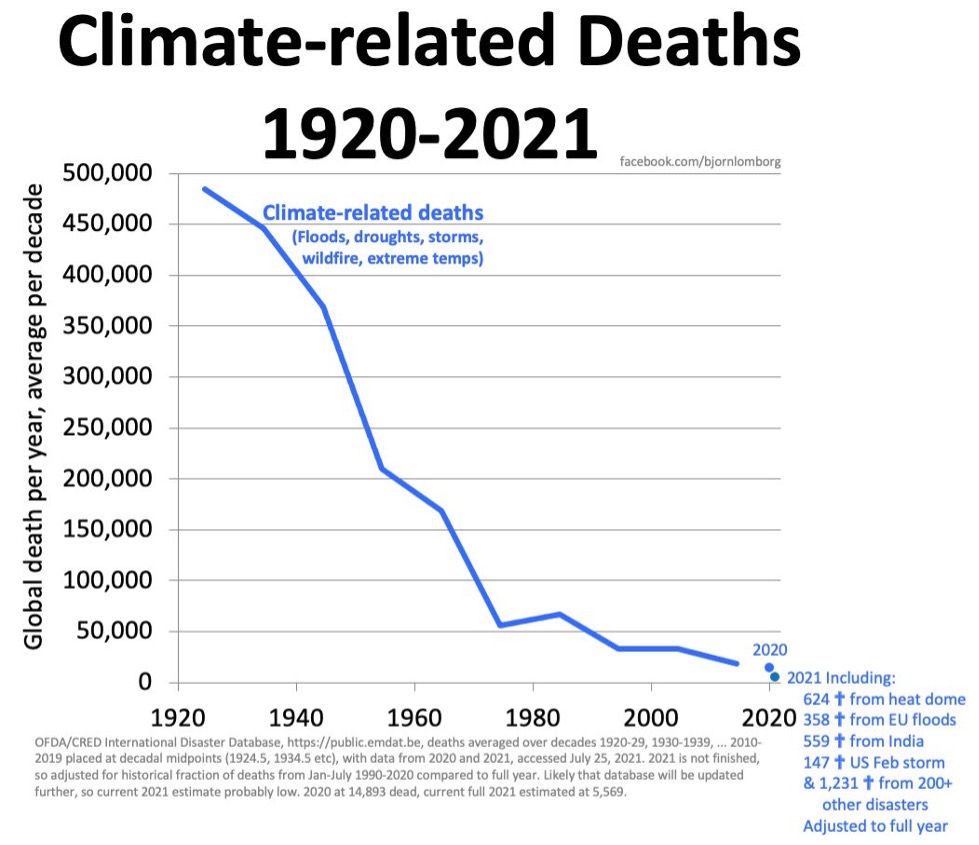
I agree. As the human population more than doubled in the past 50 years, climate-related deaths are only a third of what it used to be[0]; not a third of the rate, one-third in absolute numbers. This is mainly due to the increasing material wealth of developing countries that better lets them handle the challenges of climate.
In my opinion, the increasing centralized authority demanded by those that think climate change is a risk so urgent that it transcends legal safeguards against precisely that kind of centralized authority will harm more people than climate change ever will.
Valid point about hyperbole, but I meant ideologically in the sense that this kind of ideology crept back into the Overton window. The same occurred in the USA and refugee issues were part of the fuel.
Neither Orban nor Meloni are themselves that level of bad. I wasn’t thinking of them but of the discourse.
Now imagine tens or hundreds of millions of refugees combined with massive food cost increase due to crop failures. Orban and Meloni might be way on the moderate end compared to what might surface.
yep. life will adapt, though it may not life that we recognize.
As ocean warms say so long to Salmon on the northwest coast. Whether they will survive further north or simply go extinct altogether who can say.
Departing along with the salmon will be things that us humans in the area enjoy, such as smoked salmon and salmon on the BBQ. In the grand scheme of things likely trivial, but enormous losses to our way of life, not to mention local economies.
Greater than that are the impacts on local First Nations of whose cultures the salmon historically played a incredible role, which resulted in an outsized impact of the fish on their art, story and culture. Will be devastating when the fish disappears.
The biggest unknown impacts will be on the greater forest ecology, as it has been noted that the bears eat the salmon and drag it into the woods, where it provides food for other animals and nourishes the forest in general. As the salmon disappear there could well be a cascade of disruption and extinction on animals and ecologies well beyond what we're aware of.
The salmon will go away and yes earth will "survive" and I'm sure some another fish (or maybe just jellyfish) will fill the void. But the disruptive impacts will be utterly enormous.
It's obviously a good idea to pursue new technologies if they can make a big difference, but I'm not convinced that putting sulfides into the stratosphere is a good idea as we don't have a sound understanding of what the effects would be. History demonstrates that there's often unintended consequences of introducing novel animals/chemicals/humans into environments so we should have some caution.
The simplest solution is to stop digging for yet more fossil fuels to burn and to put our efforts into moving completely away from oil/coal/gas use. However, there's a lot of powerful money invested in continuing to make vast profits from fossil fuels and so there's going to be pushback from politicians that sit in their pockets.
>I'm not convinced that putting sulfides into the stratosphere is a good idea as we don't have a sound understanding of what the effects would be.
Neither am I, but everything I've read seems to indicate that SSI is cheap enough that many nation states could comfortably do it. That all but guarantees it will be done when places like china or india start losing tens of thousands of people to heat waves (See 'The ministry for the future' for a fictionalized account). We as a species are short sighted. We'll go for the quick fix and hope we can deal with the consequences later. The bad thing is we have no idea what those consequences will be or how to address them. It's completely uncharted territory.
That sounds to me like a politician's logic: Something must be done, this is something, so we must do it.
The first rule of finding yourself in a hole is to stop digging. Unfortunately, the world is continuing to pump CO2 into the atmosphere at an increasing rate - we should focus on stopping that before we try untested hail Mary's that are quite likely to cause even greater problems (e.g. disruption of ozone layer).
Sulfur injection may be technically easy, and who knows: it might even work. But it won't happen as long as large parts of our society debate whether climate change is serious. This kind of geoengineering requires a level of political consensus and commitment that we don't have (and that has been actively been thwarted by political parties and emitting industries.)
If the people who don't believe we have measurably changed the earth's environment by dumping carbon into the air for centuries suddenly decide that dumping sulfur emissions into the air is something we must avoid because it COULD measurably change our atmosphere I think it's time to consider them actively hostile actors.
I omitted to enumerate corporations above. Plenty of those have the resources for it, Exxon and BP included - the estimates I've seen are in the order of tens of millions of dollars per year, with capex amortization included. It's not as if oil companies haven't known about the externalities for a long time, probably longer than a lot of participants in this discussion have been alive. Do you think they're more likely to declare their entire business model obsolete and close shop, or to investigate the option?
Resource extraction companies have huge investments in existing and future wells. They're not dumb -- they know that continued extraction of fossil fuels at today's rate isn't sustainable -- but they also know that their current stock price is propped up by the perception that it is.
The game here is to extend the period of time during which those resources can be plausibly exploited. Every additional year translates into trillions of dollars. Allowing the development of a popular consensus that global warming is "bad enough to spray stuff into the sky to cool the earth down" would be absolutely catastrophic, since it would also reduce the window they have to exploit those resources. These companies aren't good or evil, they're just amoral: and they'll do everything they can to prevent and delay that consensus from forming, even if (1) sulfur injection wouldn't directly hurt their business, and (2) opposing action kills us all.
> Allowing the development of a popular consensus that global warming is "bad enough to spray stuff into the sky to cool the earth down" would be absolutely catastrophic, since it would also reduce the window they have to exploit those resources.
Would it? The entire global economy runs on those resources. I think you're overestimating how willing governments and publics worldwide would be to accept "spray stuff into the sky to cool the earth down" over "change literally everything about how everyone lives everywhere," especially when the second one has a cost in lives much more easily measured (and propagandized!) than the first.
We’re already in the process of making that change. Wind and solar and storage are going to wipe out most fossil fuel usage within a few decades, and it’s pretty obvious that fossil fuel interests realize this — you can see it in the way firms are shifting investments from new resource development into profit-maximization. This will happen even if governments don’t put their thumb on the scale, but they certainly are doing that: the political pressure to transition is only going to get more intense as we see more severe weather events.
The question isn’t “can we keep using (substantial amounts of) fossil fuels long term”, that’s decided. What’s up for debate is how quickly we’ll reach the tipping point where it becomes obvious to investors that existing reserves are stranded. This will be a long time before we stop using lots of fossil fuels! The battle that (smart) fossil fuel companies are fighting is to push that date a decade or two into the future.
I hope and wish for a future where there is a reasonable accommodation and fossil fuel interests support action on global warming, even if it’s only SRM. In the real world I think these companies are fighting a vicious rear-guard action to get every scrap of profit out of the industry before it folds up and dies. It’s going to be messy and destructive and the strategy right now is to promote denial and sabotage anything that could result in further political consensus for rapid decarbonization.
Does it, though? Isn’t this a rich individual or small group of individuals can pull off in clandestine ways? Or at least get started developing the technology for? I know there are people on this forum who are doing exactly that.
Alternative hail mary solutions with fewer systemic downsides, like assassinating fossil fuel lobbyists, seems preferable to sulfides in the stratosphere for now.
I am embarrassed to admit that I agree with this strategy. It's a real Trolley Problem, and our own children are currently in the path of the speeding trolley.
I’ve come to the following conclusion: scienctists have proven beyond doubt that anthropogenic climate change is real. Politicians and business interests have proven to be equally useless in addressing it. We know it’s a problem. Now it’s up to the engineers to solve it, or at least start implementing small-scale engineering-led solutions that go beyond “research”. It’s time to start building & figuring things out. Time to ignore the politicians and naysayers and just solve the damn problem.
Or the even simpler solution: raising gas taxes to discourage people from driving. Adding a tax on carbon pollution to make products reflect their actual cost. It's not hard, but anyone proposing "drive less" might as well be Hitler for how they're received by the general public.
Right, but you only need a couple crazies to put the fear of eco-terrorism into the heart of rich people.
Except that just leads directly to really really oppressive facism, because plenty of people already want that for various reasons, and the public news already has no qualms about calling people throwing paint on a picture "eco-terrorists" while being utterly mum about the people actively plotting to harm politicians because they aren't facist enough.
Politicians will happily jump at the opportunity to enact what they're actively trying to do.
The politicians have proven to not provide an effective front. This would be the preferred front if politicians really would enact taxes, however, history shows otherwise.
While unfortunate, it still seems like ultimately a net positive (in at least several major moral calculi) even for the smallest ratchet down of the projections?
... is not really applicable in this case as the physician's left hand continues to stab the patient while the right hand dithers about appropriate treatment.
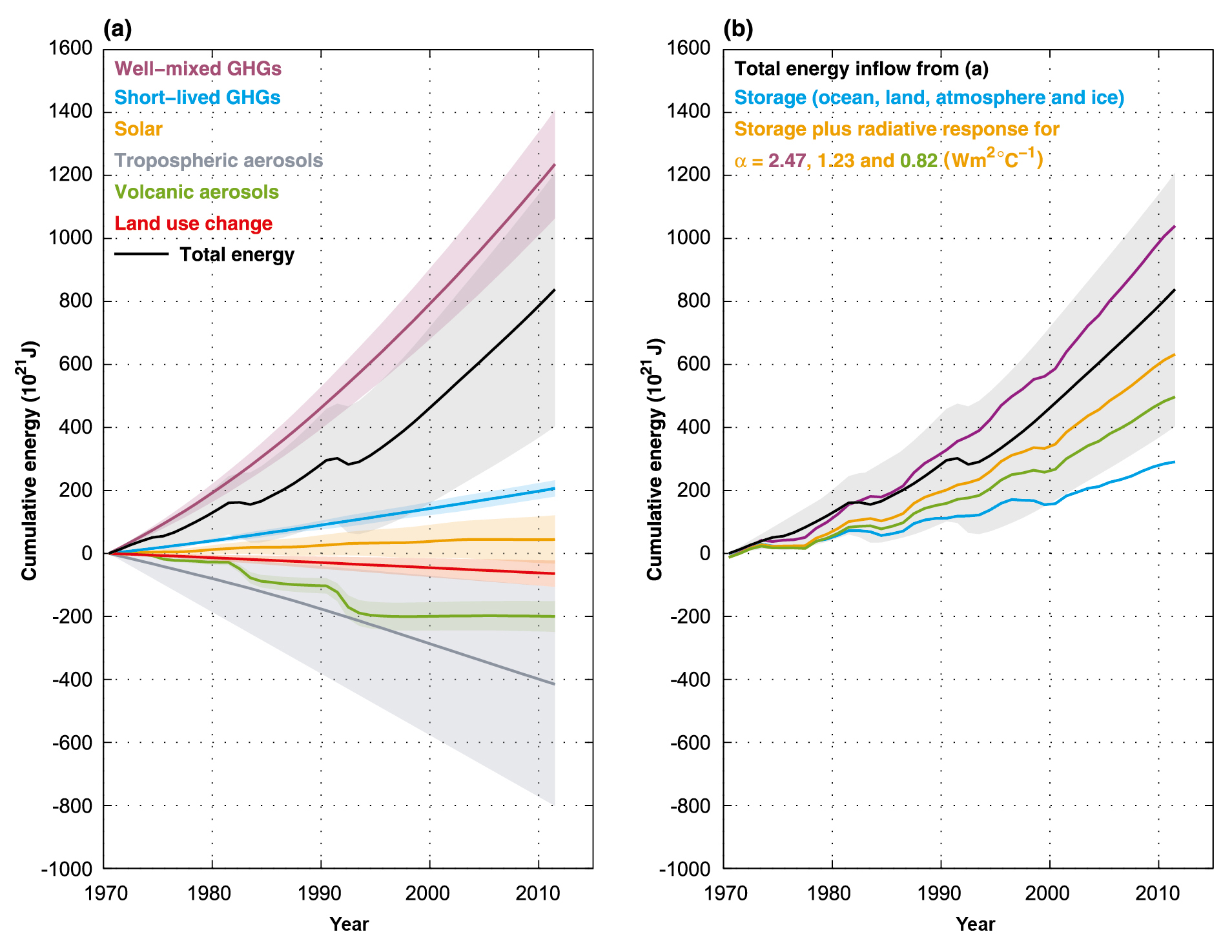
I thought climate researchers have a fairly good understanding of the outcomes of high-altitude aerosols, since the reason sea level rise is trending slightly below the central estimate of IPCC 1990 is volcanic activity. See: negative forcing from aerosols https://www.ipcc.ch/site/assets/uploads/2018/02/WGI_AR5_FigB...
I don’t see complete collapse - but I do see the doom of billions. The security states that have been set up over the past decades, the increased hostility to migration, all of this is a prelude for what inevitably follows, when vast diaspora try to find a better life outside of their bankrupt, climate-change-ravaged countries.
It’s going to get ugly. Being anything but wealthy in a sufficiently wealthy country is going to be uncomfortable, to say the least.
There will be famine, fire, flood, pestilence, and all the rest - but unless we entirely lose our heads, which isn’t impossible but remains less than probable, humanity will go on, chastened and winnowed.
Yeah, it would be very hard to entirely wipe out human civilization in any form, even in the worst of scenarios; but I expect that the world as we know it today will seem like a lost paradise compared to the one I will leave when I die.
Start thinking about how FUCKED the tech industry will get when your average person can barely afford the basics, let alone the ballooned price of garbage goods that an advertising economy requires to keep up the current system.
I’m in my mid 20s and I’ll be having kids despite the doomerism. I believe it will get worse, I honestly think we’ve experienced 1% of how bad it will get. But I also believe we will overcome the effects of climate change through strict regulation, funding, and scientific + engineering developments.
I get the idea that you don’t want your kids to suffer. But what’s the alternative? Just let the climate change deniers populate the earth with little deniers who continue polluting? We need coming generations to help us solve this.
> all of their low rcp outcomes depend upon direct carbon capture, a technology we haven't really figured out yet,
I was flabbergasted when I discovered this, absolutely none of the media mentions this. You can read right wing, left wing, looney wing- unless you are one of the 0.1% of people that read the report, no-one knows this.
One you realise that the only 'hope' is a technology that will ,at best, just cost a colossal amount of money and needs to be deployed at the scale of the oil industry, the position changes.
This problem is not solvable through capitalism without strong regulatory burdens placed on emitting carbon, a solution that oil companies actively "seek" because they know it will never happen, and their marketing directors are on video saying exactly that.
"""
UNITED NATIONS (AP) _ A senior U.N. environmental official says entire nations could be wiped off the face of the Earth by rising sea levels if the global warming trend is not reversed by the year 2000.
"""
"""
The following year that notable news magazine, Newsweek, April 28,
1975, under its Science section in the back, talks about the cooling
world. There are ominous signs that the Earth's weather patterns have
begun to change dramatically and that these changes may be bringing a
drastic decline in food production throughout the world.
"""
I’m going to have a hard time responding to this comment without breaking HN guidelines by being completely candid about how irresponsible, uninformed, and bad faith your comment seems to be.
But let me go ahead and try: one anxiety-riddled UN official and a random Newsweek article do not represent, or supersede, scientific consensus. Your points are not only irrelevant, it’s not even clear to me why you felt the need to bring up either of these links as if they carry any weight at all, or are corroborated meaningfully by any members of the scientific community.
If you care, Newsweek and Peter Gwynne, the author of your mentioned 1975 article, have both independently retracted and clarified their positions and recognize the nature and significance of modern climate change: https://www.newsweek.com/newsweek-rewind-debunking-global-co...
Nonsense. This debunking will be debunked in due time once the party line shifts and the narrative will need to be updated. I am old enough to have witnessed these wild gyrations in real time.
According to you no links that deviate from the narrative carry any weight, but they were very on point, providing a bit of historical perspective and suggesting that ignoring these sensational headlines and cries about imminent death would be quite prudent. Greta had to remove her twit recently warning that humanity would die by 2023, quietly memory holing the message that used to be plastered all over the media. Irrelevant? How dare you!
Seems so counterintuitive when you read about these massively hot sea surface temperatures. I think the long term rise in sea level temperatures as a trend is more worrying than any one season, as the overall potential for a super-normal event is apparently rising.
Hurricanes don’t matter. Houses built in hurricane zones these days are built to strict code, every new construction is concrete blocks and impact windows, hurricane resistant roofs and doors. Some flooding occurs, but water dries up eventually and things go back to normal. They don’t have those little thin wall wood houses like they do up north.
I am not an expert. I'm just trying to contextualize the poor journalism in this article.
I don't know how the same article can say, 'Scientists are just really scrambling to keep what we have alive. It’s pretty crazy that at this point the best solution we have is to take as much coral out of the ocean as we can', 'while a lot of the coral was in OK shape, up to 10% of it was dying at the lab' and 'This is akin to all of the trees in the rainforest dying' in the same article without addressing the obvious discord of these statements with some objectivism, nor how much of this is about losing diversity for species that are not resistant to warming ocean temperatures (a very well known phenomenon) and how much of this is losing species that aren't resilient or are otherwise rare to start with (the article specifically states, "It includes corals like Staghorn and Elkhorn that are “threatened” under the Endangered Species Act because there are just a few hundred genetically unique individuals left").
We know it's bad, and it's a problem people are passionate about, and it's related to higher global average temperatures, but we have scientific models and don't need to rely on personal verbiage or sensationalism to understand the impact. How does this vary from existing models? Was this unexpectedly early? What is the implication for it happening earlier in the years compared to other years in terms of annual averages?
Phrases like, "depth refugees" and "little hope spots" do not help us all understand what's actually happening or the degree of the problem compared to predictions.
I witnessed the reefs in the Great Barrier reef go through bleaching over the last few decades, and it was horrific to behold personally. This article is making me feel dumber.
The results of the Australian bleaching were unintuitive, because the reefs actually ended up growing back to their highest levels after the events, though much like secondary succession in a forest it ends up favoring fast growing species and that has implications:
https://www.abc.net.au/news/2022-08-04/great-barrier-reef-re...
The rapid growth in coral cover appears to have come at the expense of the diversity of coral on the reef, with most of the increases accounted for by fast-growing branching coral called Acropora.
Those corals grow quickly after disturbances but are very easily destroyed by storms, heatwaves and crown-of-thorns starfish. By increasing the dominance of those corals, the reef can become more vulnerable.
This research helped me contextualize some of this continually sensationalist and frankly utterly shit quality journalism in the CNN article.
Here's the most relevant parts of the nature article. Though the overall article is worth reading, this might be the most helpful part for those who don't want to read the whole thing:
In concordance with the global predictions24,25,26, in the last decade, coral bleaching has increased in frequency and intensity (Fig. 3). Yet, in the last decade, the onset of coral bleaching has occurred at significantly higher SSTs (~0.5 °C) than in the previous decade (Fig. 4). At the thousands of sites surveyed, the mean SST recorded during coral bleaching in the first decade of the dataset, from 1998 to 2006, was 28.1 °C, whereas the mean SST recorded during coral bleaching in the second decade, from 2007 to 2017, was 28.7 °C. This change in coral-bleaching temperature is significantly different (Likelihood ratio test, Pr(>χ2) = 0.001) between decades (Fig. 4). The increase in over half a degree celsius in coral-bleaching temperature suggests that past bleaching events may have culled the thermally susceptible individuals, resulting in a recent adjustment of the remaining coral populations to higher thresholds of bleaching temperatures26,27,28 (Supplementary Figure 19). Coral communities also may have acclimatized to increasing SSTs, highlighting the need for further research to understand the context dependencies of this trend towards a greater temperature threshold.
Our model showed that rates of change in SST are strong predictors of coral bleaching with faster rates of change correlating with higher levels of bleaching (Fig. 2 and Supplementary Figure 20). Global models predict a mean increase in SST of 0.027 °C per year from 1990 to 209029, which is almost double the rate (0.015 °C per year) of the previous 30 years. As SSTs continue to increase more rapidly, more localities are likely to experience coral bleaching. We show that coral bleaching is predictable, at large scales, by the intensity and the variance in frequency of extreme, high-SST events. We demonstrated that equatorial areas and areas with greater exposure to short-term SST fluctuations may be more resilient to high temperature events, and therefore may be important targets for conservation given their increased likelihood of persisting into the future30. Coral bleaching has had unprecedented negative effects on coral populations worldwide, and immediate action globally to reduce carbon emissions is necessary to avoid further declines of coral reefs.
I'm not in denial of the science, but when people write about the science as a personal tragedy and don't include any of the relevant information to contextualize what they are saying, they lose all credibility with me.
CNN isn’t my preferred news source. Internal links just go to more CNN articles. It sounds bad. Can someone weigh in on the implications? How abnormal is this? Is this the first time it’s happened?
More here. It wasn't just one buoy - almost all the measurements in Florida Bay were near or beyond records. Yes, it abnormal - this could be a world record for hottest ocean water (previous record was off Kuwait). And it's not just Florida - the Med, North Atlantic, and waters off Peru are all seeing record or near-record water temperatures as well.
This, combined with the stalling AMOC current is bad news. expect sea surface temps to rise, the depths of warm water columns to deepen, and hurricanes that pass over these waters to explode in intensity.
TLDR: Anyone trying to insure a property within 100 miles of the south eastern coastline is probably going to have a bad time, much of florida is already in this situation today
"Earth has experienced cold periods (informally referred to as “ice ages,” or "glacials") and warm periods (“interglacials”) on roughly 100,000-year cycles for at least the last 1 million years. The last of these ice age glaciations peaked* around 20,000 years ago."
"The causes of ice ages are not fully understood for either the large-scale ice age periods or the smaller ebb and flow of glacial–interglacial periods within an ice age."


[1] https://en.wikipedia.org/wiki/Timeline_of_the_far_future