I feel like the author missed the dip caused by the April Fools joke, and tries to create another one.
I think what's Elon is trying with the automation is very similar to difficulties that SpaceX had initially with reusable rockets. At first people doubted SpaceX can replace NASA, then that it was possible to do have rockets to return back, later when it started looking reasonable but SpaceX rockets were still crashing, company like Blue Origin were making fun of them by posting video that they can already land (omitting that just getting 100km up and back was far less challenging than what SpaceX was trying to do).
Eventually SpaceX succeeded and this resulted with much cheaper cost to send satellites to space.
To me it looks like Tesla is going through same thing, they try to automate all manufacturing instead of doing what everyone else is doing, this might make things bad at first, but once they succeed it will be very easy to scale the production and the only limitation will be the supply.
I believe in Tesla primarily because of Elon, he is kind of a guy who doesn't have word "failure" in his dictionary, if Tesla doesn't succeed then most likely what they were trying to accomplish was impossible.
Elon is a fundamentals kind of guy and that drives his strategy. The fundamentals with respect to electric cars from the time he started were:
a)electric is a much better technology than ICE for automobiles. Electric is way simpler, lower center of gravity means better handling, smaller and lighter motors mean more interior space and better performance. Battery tech is a pain point but no CO2 is essential for everyone.
b)Large automakers know this but simpler for them translates into less maintenance which means lower profits. Automakers therefore will pay lip service to electrics, drag their feet and kill off any real electric competition if they can. The world's environment is not a shareholder in the large automakers.
So his "master plan", (the Truth but not the whole truth) he published in 2006. What he left out was that he knew as he moved to a high volume model that's when the large automakers would try to cut Tesla off at the knees and then go back to resting on their laurels.
If his high volume model was mediocre and expensive to build Tesla would be dead in the water. He needed an excellent car but even more than that he needed Tesla's cost to be much lower than the majors could match so they couldn't low ball the market long enough to cut off Tesla's oxygen.
When Tesla got 400k Model3 pre-orders that's when he decided to double down on the 'low unit cost/large production investment' strategy for the model3. Making this work is critical to Tesla's strategy. You can be sure Musk and his team put a lot of effort into the production tech knowing it was make or break for Tesla.
The Economist is under estimating Musk and they should give him a little more credit given his track record. Telsa is not a slam dunk but it's also nowhere near as fragile as they make out. Musk also has a bit of equity in SpaceX he could lean on if the markets demur at the end of 2019.
> The Economist is under estimating Musk and they should give him a little more credit given his track record. Telsa is not a slam dunk but it's also nowhere near as fragile as they make out. Musk also has a bit of equity in SpaceX he could lean on if the markets demur at the end of 2019.
Tesla is going to run into issues in 2019 if they are unable to ramp up the Model 3. Tesla lost $1.6 Billion last year, and they only have $3 millionish in cash. Furthermore, Tesla has debt that is due in 2018 (~$300 million or so) and early 2019 (~$900 million).
Over the next year, Tesla needs to pay off $1.2 Billion in debt, AND needs to increase revenue by ~$1.6 Billion or so to stay even. They're not exactly in a good situation.
I'm relatively confident that Mr. Musk can raise another $3 billion in capital through stock offerings or rolling over their debt in the short term, but those options have some risks involved. Furthermore, people will not want to lend money to Tesla if they think that the company is sinking.
-----------
All the while, Tesla has bought SolarCity and also inherited all of its debt and issues. Tesla was having enough issues ramping up Model 3, but now they ALSO have to make the solar company profitable too. It was a bad time to buy SolarCity.
I’m not sure I’d agree. The Model S is quite prone to understeer, and it’s not just slight understeer but real unrelenting understeer. I’m not sure how though because there isn’t a lot of weight over the front axle that would cause the nose to push wide so perhaps it’s because of how the suspension is setup. This is quite unlike the BMW M5, for example.
> b)Large automakers know this but simpler for them translates into less maintenance which means lower profits. Automakers therefore will pay lip service to electrics, drag their feet and kill off any real electric competition if they can. The world's environment is not a shareholder in the large automakers.
If I'm not mistaken, maintenance translates to profits for dealers which are completely different from manufacturers (unless you're talking about Tesla). From the standpoint of the manufacturers, it's in their interest to force people to buy new cars instead of buying them, so they should be making cars that fall apart quickly--except the evidence is that car quality has dramatically improved over the past 40 years.
>Large automakers know this but simpler for them translates into less maintenance which means lower profits. Automakers therefore will pay lip service to electrics, drag their feet and kill off any real electric competition if they can.
That might have been the original plan, but nowadays it would be suicidal. That is because the Chinese government is totally committed to EV's. I am sure the mainstream auto execs are totally aware of that.
I recently learned that he was into ultracapacitors in college and very early wanted to go into EVs. He's often portrayed as a rich internet dude that learned rocketry but he had an actual serious background. That's not everything but it's a bit less shallow foundations and Tesla battle is not against the elements but against markets, a tad different.
Zetsche, Mercedes Benz CEO, just admitted to Shareholders that they will switch to electric cars, but it will be bad for their bottom line. That's why they are dragging their feet.
1. Electric != electronic. Electrical engines have been a staple of engineering for about 200 years, about as long as ICE. Integrated circuits, on the other hand, have only been around for some 60 years, and while those are pretty reliable on the hardware side, we're still figuring out how to manage the complexity that they enable, and how to make software that's not shitty.
2. One anecdote does not a rule make.
3. "When you make a motherboard that works properly for more than 5 years, let us know." Maybe you should stop buying bottom-shelf. I've seen 10-year-old Thinkpads work like they did on the first day. And my current Asus notebook is already 6 years old and shows no sign of old age at all. Even the battery still holds over 80% charge.
You’re both right. Industrial electric motors run 24/7/365 for decades in all sorts of harsh conditions. The motors should not be an issue.
On the flip side these cars are filled with electronics. Just look at the dash... I don’t trust those to last more than the warranty period. However, I feel the same about most modern cars, especially luxury cars.
SpaceX cannot replace NASA, at least not yet. SpaceX is a component supplier to NASA like Boeing, United Launch Alliance, etc. There's a whole lot of other stuff that NASA does that SpaceX is not even trying to do.
So capitalism is supposed to be about taking risks and (potentially) getting rewarded (so we are told, although in reality it seems to be about establishing a monopoly or extracting corporate welfare from the government).
So here's a company (or two if you count spacex) that is taking huge financial and organisational risks and running at the edge of their capacity to expand all the time and all the industry observers just shit their pants in fear about it and try to shoot it all down.
> So capitalism is supposed to be about taking risks and getting rewarded (so we are told, although in reality it seems to be about establishing a monopoly or extracting corporate welfare from the government).
I like how "taking risk" is talked about as if it meant "statically you will gain out of it". That is not what risking means. Risking means that you can either loose or win and that plenty of people really loose. Risk does not entitle you to reward.
The emphasis is always on "getting reward" each time "taking risk" is said where "getting punishment" is never said. That is not what capitalism is supposed to be about. That is just a glib used by people invested into treating risk taking as some kind of virtue (will, virtue if you get rewarded, if you the bad part of risk happen you are lazy looser who deserves no sympathy).
The capitalism is supposed to be about rational decisions in competition and environment of reasonable transparency. Which may mean taking risk or not taking risk depending on how likely the reward part is to happen and how much punishment there would be.
> So capitalism is supposed to be about taking risks and (potentially) getting rewarded
No, capitalism is about owning capital and getting rewarded. That's why it was called “capitalism”, and not “riskism”. That's why, while all actors in the system take risks, the lions share of the rewards go the holders of capital.
But, anyhow...
> So here's a company (or two if you count spacex) that is taking huge financial and organisational risks and running at the edge of their capacity to expand all the time and all the industry observers just shit their pants in fear about it and try to shoot it all down.
SpaceX coverage is fairly positive, so let's not count them in this criticism. The financial press is frequently negative on Tesla because they repeatedly keep failing to meet what Tesla management announces they are going to do (with production targets for the Model 3, they've repeatedly failed to meet them, adjusted then downward, and failed to meet the adjusted targets.) Even to the extent that it's defenders characterize capitalism as being about rewarding risk taking, they don't say it's about rewarding blind risk taking.
I’m really interested in how you see NASA being replaced by SpaceX, though my initial feeling is that you have might have a very limited idea of what NASA does.
Can anyone here even imagine trying to pull off a Tesla? Burning through billions, haters at every turn, safer products that alas lead to deaths, huge pieces of hardware that must be recalled to fix, and on.
> I feel like the author missed the dip caused by the April Fools joke
The slide from $310 to $250 happened in the 10 days prior to April 1, after it became clear autopilot was turned on in the recent California Model X accident, which is exactly what the author says.
Presumably banks have propped the stock back up to the current $298 and are running PR cover in an attempt to make back some of what are inevitable losses. I can't imagine anyone on r/teslamotors buying more right now. The general consensus is AP is not up to snuff. Only people investing other people's money would try to save TSLA right now.
I think Tesla would've been fine with robotic manufacturing and electric vehicles. With autopilot, they've entered risky territory in order to earn investment dollars. It's not clear whether or not that risk will pay off. It seems clear now that full self-driving isn't happening any time soon without lidar.
I'm not sure if you read the article or not, they are attributing the slow down Tesla has in production because apparently Tesla is betting on automating everything related to production as opposed to what other automobile companies do which is only automating things that are easy to automate and make people do the rest.
Ehm, they are the world standard in manufacturing, and that standard rather famously includes letting humans do a lot of the general assembly. No one is raining on Toyota, they are excellent at almost everything.
You know that Tesla uses way more people per car than say a GM or Toyota in their assembly line...right ? This number may go down in the future but it is a fact right now. Don't take my word for this: http://www.autonews.com/article/20170611/OEM01/170619951/tes...
It's because in this temple of lean manufacturing, Tesla uses far more workers than NUMMI employed to build far fewer cars. In 1985, its first full year of production, NUMMI had 2,470 employees and produced 64,764 vehicles — about 26 vehicles per worker per year. By 1997, it had 4,844 workers and produced 357,809 vehicles — about 74 vehicles per worker per year.
Tesla, on the other hand, had between 6,000 and 10,000 workers in 2016 and manufactured 83,922 vehicles. That puts its vehicle-per-worker number between 8 and 14, about one-seventh the efficiency of NUMMI at its peak.
Yea, but sadly he’s going about “beating” the standard using the mantra robots are better than humans, which is just not true. When you have a process that’s not a bottleneck, with enough throughput that’s cheaper to do manual, the only thing you do by using robots is throw away money, increase your potential for breakdowns and remove flexibility. Musk is acting exactly like the classical Lean “dufus” who forgets to analyze his process and considers robots a goal in the self instead of minimizing waste and optimizing throughput.
Tesla isn’t pushing the standards, they’re not even playing in the same league as Toyota and other established manufacturers. But they sure are good at hyping their flawed methodology.
Tesla is so secretive that nobody outside really has a clue what the problems are. Even the automotive trade press doesn't know. There are so many possibilities. As I wrote last time this came up, Tesla would probably be better off letting some competent automotive reporters tour the plant. Right now, investors are assuming the worst.
What's surprising is that Tesla is also having trouble with battery pack manufacturing. That's far simpler than building a car. It's a good job for robots, building identical units made of a large number of the same components.
I don't think Musk is running different companies at all. They are all the same, working towards the same goal - a city on Mars. Such a thing, should really benefit from totally automated factories.
And I would not be surprised if part of this will be a massive simplification of the current "cable trees" with cables from each component to the central fuse board to something like 2 24V power rails and 2 high speed data buses (one for safety critical stuff, the rest for everything else), with plugs every 20-30cm or so, fuses inside the components themselves and everything controlled with intelligent boards in the components.
Installing the cabling tree is inarguably one of the most complex parts in building (or, for what it's worth, servicing/maintaining/extending) a car and also the part where you right now need humans in the loop. By including the power rails e.g. directly in the car's composite frame and only running a tiny strand of wire for the bus you save a boatload of money.
For your information, both Toyota and other automakers already tried the "automate all" approach, and they reverted because the economics didn't work out. This time it might be different, or it might not.
I understand people WANT to defend Tesla here, but there are some really rubbish arguments people are trying to push and especially some that border on conspiracy theories.
Tesla has real problems: The first is that it's failing to meet production targets. There's no way around this, the company is on rocky times and while I'm sure that given unlimited time and resources they could get to the production targets we don't live in a world with infinite time and money. Other players in this market are moving quickly, if you want to see a compelling example of electric technology the Hybrids from Toyota are great, and they're producing 10 million cars a year. So it's not a sure thing that Tesla ever becomes a leading car manufacturer (and therefore pays off its debt and shareholders).
Even then, there are serious questions about the full automation of their production line - what is that point of a robot doing everything if you're paying more to run the robot than a human would cost to do the same thing? Industry analysts aren't idiots, and neither are the other car manufacturers. Even if the Tesla factory goes fully automatic years before other car companies you might find it's actually not economically beneficial. So all these problems they've imposed on themselves may not even provide benefits.
The second is that their self-driving program is hitting similar bumps to the automation. They've rolled out something early and they've opened themselves up to huge liabilities. There's good reason other car manufacturers are being very careful with the roll out- liability from accidents could bankrupt your company.
The final thing is that Tesla's accounts as a standalone company don't look stellar. They have a lot of short term debt and they need to roll that over at a time where they're missing targets and killing customers. That's a huge economic problem. The result will be either they fix problems 1 & 2 or Musk will have to issue stock at the risk of losing some control, or pump more of his own money in.
One final point I'd like to make about this: Elon Musk wanted Tesla to move everyone to electric cars. For him, Toyota or Ford selling electric cars would be a victory. For Tesla and it's shareholders that's not true. So whilst Musk may succeed, it's not necessarily going to happen through Tesla. He's done a great job of scaring other companies into Electric and autonomous vehicles. That does not mean Tesla will ever pay off to shareholders.
> Other players in this market are moving quickly, if you want to see a compelling example of electric technology the Hybrids from Toyota are great, and they're producing 10 million cars a year.
Toyota is mass-market. It's not hip. Everyone can drive a Toyota - a Tesla, though, is a status symbol. The competition in the "status symbol" range is BMW (the 7er series) - which is primarily an ICE-vehicle based company. Yes, they have the i3 and the i8 experience but that's low volume - when they try to scale up, also BMW will face issues AND they will have to either convert entire assembly lines or retrofit, both of which is expensive - compared to Tesla which HAS an assembly line, and only has to figure out how to make it work at scale. The question is, who will be faster to solve their issues - BMW or Tesla?
Wasn't the business goal for Tesla to become mass market? Toyota and BMW have their relative status symbols sold and resold by numerous dealers worldwide. And their status symbols have very regular body panel seams - the very definition of quality. These 2 companies have vast experience bringing a new car model or drivetrain component to scale, along with more factories to test with. Not to mention they could form a business partnership with each other, just like Toyota and GM did at NUMMI[0].
I don’t think Woz should be seen as a particularly relecant commentator on Tesla (Tim Cook, despite not being an Apple co-founder, would be far more interesting). But as usual, I find myself nodding in agreement with Woz’s worldview.
Not necessarily about cred, but because he's not in an industry position or otherwise has the insight that Apple "co-founder" suggests. Don't get me wrong, I think he's was as vital to Apple as Steve Jobs was in its pre-iPod era.
I picked up some at the money May calls Monday. I sold them today, and (mostly coincidentally) bought a sailboat. The options, after taxes, covered the boat and this year's moorage.
Could've gone the other way of course, but after the beating they'd taken? Surely they'd do something to correct between Monday and earnings.
They said, I might amend your statement to be emotional volatility is your friend. I mostly got lucky on the response to Tesla coming closer to meeting their production goals (entirely independently of the underlying financials). It elicited a predictable emotional response.
Most of the Tesla threads seem to directly jump from Tesla to Musk to SpaceX. The question on viability and profitability are never answered during such comparisons. I dug around to see how SpaceX was doing and I only found this article from early last year:
> Moreover, if SpaceX achieves its stated goal of sending 20 rockets into orbit by the end of the year, the $1.44 billion in revenues that implies suggests rising levels of profitability. And if SpaceX achieves its targeted 30 launches in 2018, the company should be even more profitable next year.
There were only 18 flights in 2017. So, SpaceX also missed their target but they might be in better financial health than Tesla.
For the most part defense of Tesla is similar to the ones seen for Cryptocurrencies. People often go - "This is FUD and author is trying to spread FUD to buy more coins. This coin is trying so and so technology. If it succeds then the price is going to the moon. HODL".
That said I am curious to hear well reasoned arguments on what Tesla is doing which is better than the others. Or rather going to do better.
Do you have a source for that? According to https://mashable.com/2017/08/01/tesla-model-3-true-cost-more..., the Model 3 only costs $49,000 if you buy it with an extra-large battery pack and Autopilot. Those are cool, of course, but it's still a perfectly usable car without them (220 mile range). The base price is indeed $35,000, and that doesn't include tax incentives or any other "cheating".
I'm really surprised people don't know this. But I was an early Model 3 deposit holder. I had my deposit refunded this week since I placed it based on the $35k promise, not the current situation.
The standard battery pack is not available yet (my date estimate for this slipped from Early 2018 to Late 2018).
Premium interior is also required.
"Enhanced Autopilot" is $5k.
$35k base
$9k required big battery
$5k required interior upgrade
$5k enhanced autopilot (which everyone probably wants)
$54k total
Add $1k if you want a color other than black.
Should get even more interesting when the $7500 federal tax credit phase-out begins middle of this year.
Costlier versions of the Roadster, Model S, and Model X were available before the base versions were. If Tesla had done the opposite with the Model 3, that would have been the exception.
You're wrong about all of these: Tesla was clear that the more expensive Model 3's would ship first, and S and X both shipped the most expensive ones first.
Model X deposits ranged from $5k for the base model to $40k for the Signature model. Those deposits sat for up to 3 years for early reservations.
The upcoming Roadster requires $50k and $250k deposits.
The upcoming Semi requires a $20k deposit.
The original Roadster also required a deposit.
I'm unsure of the original Model S.
Tesla's current estimate for base Model 3's is "late 2018" for early reservation holders. Take that with a grain of salt given how reliably they announce unreliable release dates.
This is incorrect. As soon as you place your deposit, you're in the queue. The queue tool didn't exist until roughly Summer 2017, but deposits started March 2016. There was a period of more than a year where everything was opaque.
On another thread I asked if you have a source for this - I'll ask again, because I can't find one. I didn't follow the Model S/X stuff too closely leading up to the Model 3 (I don't spend that much money on a depreciating asset). I did put my Model 3 deposit down the first day possible, and I do not remember any such "clarity" you describe around timing and expectations.
Then again, originally my standard range Model 3 was estimated "Feb-Apr 2018" or something like that. It now just says "Late 2018" and I have no faith that will be met, either.
Hah, one of the many reasons being scammed into buying a model S was they promised Tesla owners would have first access to Model 3 back in Oct'16 but they failed to mention that the base $35 + 5K autopilot model would be another year later after the $49+5K model
The article cites the reasons why the author arrived at the conclusion. I think usually articles in Economist are fairly accurate. So keen to know why you think this to be a bad article.
I’m really glad I dumped TSLA stock while I still some profit. For a while I had drank the koolaid and it really tasted good, I even had my preorder for a Model 3. But it has become clear they aren’t that great as a car company. Other manufacturers will surpass them, and then what? I rate this as a sell.
"Saloon" as a British-ism for "sedan" is a new word for me. As for the article, likely needing to "raise additional capital during the second half of 2019" is a far cry "uncomfortably close to the truth" of totally bankrupt.
If you read the original Moody's announcement, Tesla needs a capital raise this year and next year. A company that needs annual multi-billion dollar injections of capital to survive is indeed, uncomfortably close to bankruptcy.
The original plan was to use profits to fuel the expansion. However, there was no profits and they used debt and capital raises instead. Unfortunately, the expansion generated no profits of its own, only huge losses, requiring even more debt to expand further. Eventually, there was a vicious cycle of debt, losses, and more debt need to expand further, leading to the situation you see now.
Because they lose money and need to borrow more? But in any case, regardless of why they have it, whether they keep expanding or not: they need to pay back that debt and they won't have the money for it. It's as simple as that. Does that make sense? So no, they can't survive if they stop expanding. The only way to survive is to either be profitable within the year or raise more capital.
> "Saloon" as a British-ism for "sedan" is a new word for me.
I believe it derives from the saloon ( main passenger accommodation ) of a bus, versus the open deck of a charabanc. In turn borrowed from the maritime sense of a large weather-protected cabin for passengers.
In British car terms it indicates a car with 'separate' accommodation for the passengers i.e. not integrated with the boot / trunk as found in a hatchback.
It's incredible how "the money" believes jokes, uses one accident to throw all the work out of the window... I see how they believe on the project... As musk said "It kinda sucks running a public company".
I thought that a Tesla bankruptcy would be cataclysmic. But then I realized that Elon would kind of welcome it.
Spacex has established itself as a sort of technological monopoly, where its launch prices are $70m, but the competition is $90m, but because of their technological monopoly, and their true cost of launch is $20m. And now they are on a launch cadence of every two weeks, (that is $50m in contribution margin every 2 weeks, that is $100m in profit per mo., locked in forever well at least until ULA has a competitive offering (forever+1).
With that as your option set, why fuxk around with 200 versus 300 cars made a day.
"The point of [building Tesla] was, and remains, accelerating the advent of sustainable energy, so that we can imagine far into the future and life is still good."
How does Teslas strategy fit in with the ascendance of for hire vehicles like Uber? It seems to me rich coastal types who can afford a Tesla, may just decide to ditch driving all together and just "Uber" everywhere.
Tesla as a company will be fine if they start focusing more on other initiatives (trailer trucks, solar panels, batteries, etc).
“Self-driving” fancy/family cars aren't a good solution for the future of our already populated cities. Mass transit is. Hyperloop/TBC have a lot more growth potential than Tesla's Model (x) line does.
I was one of Tesla motors' biggest fans but I can't in good faith support them (not Tesla Inc) over a proper public transport solution. It is at best a short term solution and doesn't push humanity forward.
10-20 years down the line I can see them spinning off the Passenger car division, or they will see it impacting their other projects negatively.
Hyperloop has no growth potential, and TBC might (depending on how competent they are at bringing tunneling costs down, which doesn't have good augurs at the moment).
The problem with the "mass" transit concepts of Hyperloop and TBC's skates concept is that they are trash at throughput [1]. Furthermore, as unproven technology, that means that you're unlikely to win contracts without spending the company's own money building demonstration tracks. Even early contracts are likely to be structured in such a way that substantial portions of cost overruns are borne not by the public.
[1] Capacity is primarily determined by station dwell times and switch clear times, which means it's driven primarily by consists per hour. The original proposals here basically propose passenger capacity per consist that's in the region of 1% of bespoke mass transit systems.
They should. It looks like Waymo & partners will easily beat them to market on the electric & autonomous car future, anyway.
Big energy companies tend to have a market cap at least 10x big car companies, anyway. That's where their future is.
The only way I see that they could turn the car business around is if they somehow get to full autonomy in the market very soon, and then (per master plan part deux) essentially are selling cars as a means of having car owners investing in their autonomous rides network. The clock is ticking on that, though; Waymo seem to be scaling very aggressively.
Yes Google/waymo has been at it since 2009. Musk better deliver the self-driving vaporware [1] he started selling since Oct'16 as shown in the video in https://www.tesla.com/autopilot before he can stall the lawsuit [2] any further...
They've been having a cash crunch since day one; the only reason they exist is that the American taxpayer has been milked to the tune of $4.9 billion to support them.
>This $4.9 Billion figure has been thoroughly debunked. It includes hypothetical tax breaks that Tesla could receive 20 years from now, discounted loans that Tesla long ago paid back in full and in advance, and even money from programs that Tesla never receives, but customers can potentially benefit from.
If an industry has a realistic prospect of making a serious dent in that number, subsidizing it IS the "moral" thing for a government to do, in my opinion.
Taxpayers actually subsidize almost every industry. States and various local governments give tons of incentives and loans of different kinds to projects / startups and companies for different reasons. (one popular reason is generally to get companies to create jobs in their area), but the US federal government will also fund private enterprise which could create new and emerging industries. The government usually does this for it's own self interest. The government wants to take on these projects to boost the economy or industries. Using perfect economics... it's not optimal not to pick winners in a market but the world has a funny way of making things more complex than basic economic models (ex the energy industry, where overtime it is not advantageous to allow the market to pick non renewable resources but the market still might until everything is gone :) )
It seems like crony capitalism refers to a scenario where the money from government investment goes directly to the pockets of players in the industry. (this is what is believed to have happened in Russia over the last 2 decades..one example being multi billion dollar construction projects for olympics with nothing to show for it).
That doesn't seem to be what happens in the United States (in most cases). Most major innovation still needs the government to chip in. Google's alphabet (so far) has show that this kind of innovation system is really hard for a private company to drive ever when they have almost unlimited resources. So if we have clear evidence (and we do... Moon landing , internet, electric cars, new space race, self driving ) government investment drives us forward (in aggregate) what is morally wrong about the US government participating the economy?
And not to nit pick but are you sure the dollar figure really doesn't matter? There's a profound difference between ~500 million (the loan Tesla actually got) and 4.9 billion dollars (fake number pushed by media w/ agenda)....
Most of this stuff is not subsidy in the sense of the govt/taxpayers writing a cheque to the company. They are tax breaks where the company writes a cheque to government but a smaller one than they might of otherwise. As to why have tax breaks - why not? Rather than have every company pay 35% of profits why not have deductions for this and that? Pretty much all countries do it to some extent. Admittedly its a problem if the system gets corrupted and you get things like hedge funders only paying 15% mostly because the donate to the right politicians/lobbyists.


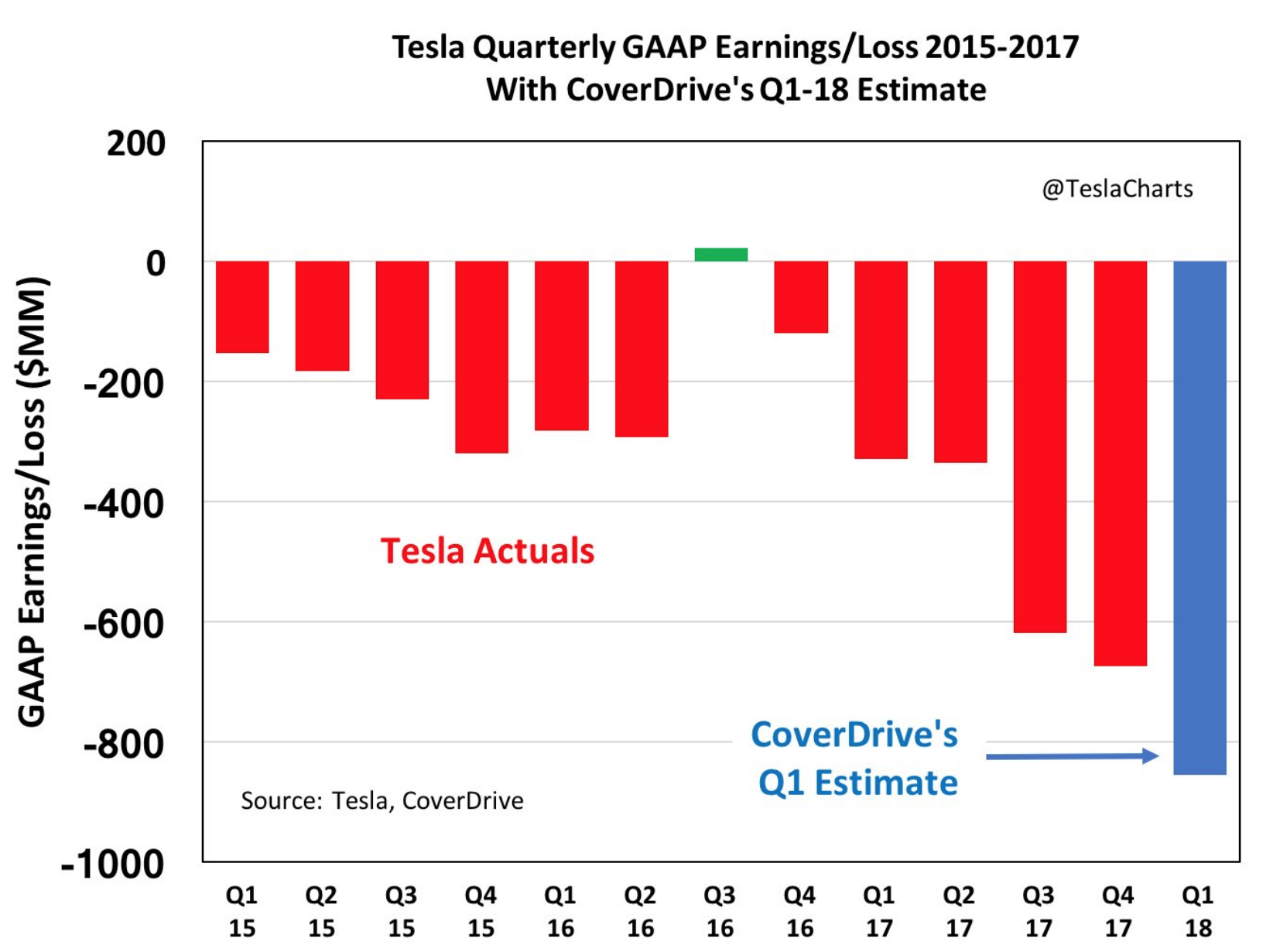
I think what's Elon is trying with the automation is very similar to difficulties that SpaceX had initially with reusable rockets. At first people doubted SpaceX can replace NASA, then that it was possible to do have rockets to return back, later when it started looking reasonable but SpaceX rockets were still crashing, company like Blue Origin were making fun of them by posting video that they can already land (omitting that just getting 100km up and back was far less challenging than what SpaceX was trying to do).
Eventually SpaceX succeeded and this resulted with much cheaper cost to send satellites to space.
To me it looks like Tesla is going through same thing, they try to automate all manufacturing instead of doing what everyone else is doing, this might make things bad at first, but once they succeed it will be very easy to scale the production and the only limitation will be the supply.
I believe in Tesla primarily because of Elon, he is kind of a guy who doesn't have word "failure" in his dictionary, if Tesla doesn't succeed then most likely what they were trying to accomplish was impossible.